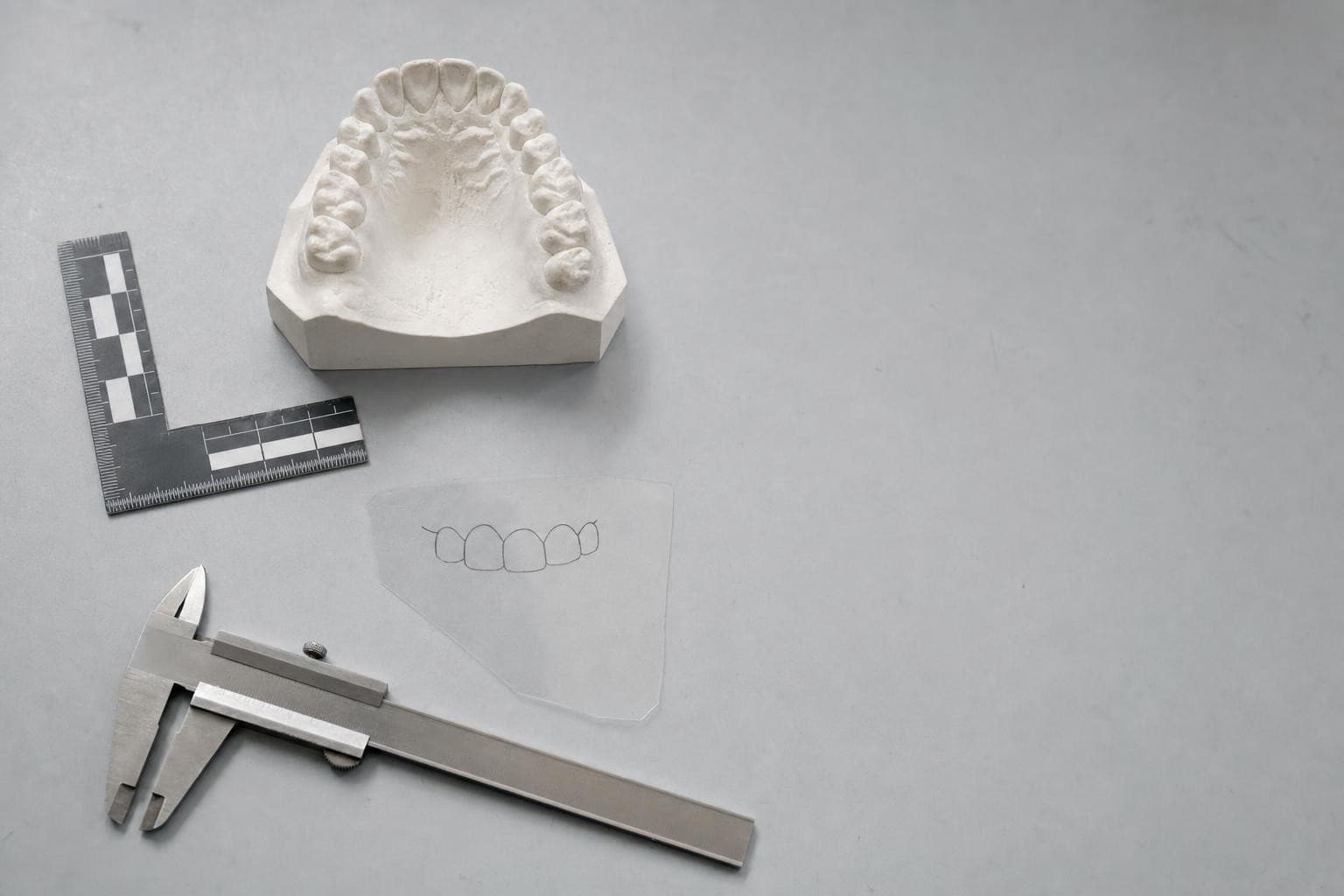
Bite-Mark Comparison: Two Premises Under Test
Bite-mark comparison has the weakest scientific foundation of the pattern-comparison disciplines and one of the worst records in court. It rests on two premises, that a person’s teeth are unique and that skin records them, and convictions built on it have put innocent people on death row. Six sections test both premises against the statistical evidence, the distortion experiments, examiner disagreement, contextual bias, conclusion language and the wrongful-conviction record.
The claim of a unique dentition
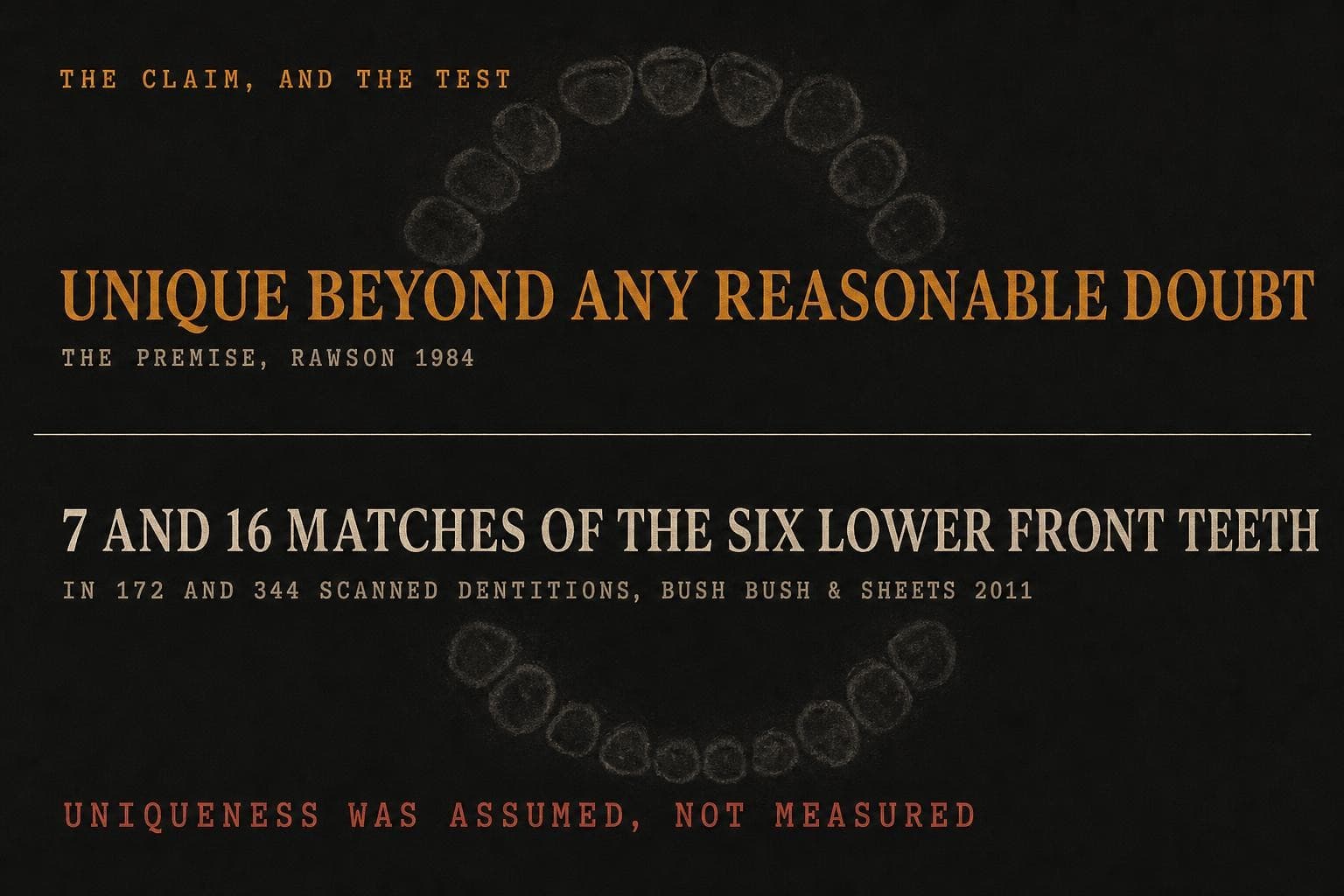
Bite-mark comparison was used to convict people for decades before anyone tested whether it works, and when the tests came they went against it. It rests on two premises. The first is that a person’s teeth are arranged in a way shared by no one else. The second is that skin bitten by those teeth records the arrangement well enough to compare. For decades the discipline treated the first premise as settled. The paper the courts leaned on was Raymond Rawson and colleagues’ 1984 study, "Statistical Evidence for the Individuality of the Human Dentition." They measured bite impressions in wax, applied the product rule by treating each tooth’s position as independent, and multiplied the probabilities to a number so large that a match of only five teeth would exceed the world’s population. Their conclusion was that the dentition is unique "beyond any reasonable doubt."
The distinction worth holding onto is what was observed and what was inferred. What Rawson measured was tooth positions in a sample. What he inferred, by multiplying, was that no two people share them. The inference depends entirely on the teeth varying independently.
They do not vary independently. Teeth crowd and lean together, so their positions are correlated, and multiplying correlated quantities as if they were independent inflates the rarity. Mary Bush, Peter Bush and David Sheets tested it directly in 2011, in a paper titled to answer Rawson: "Statistical Evidence for the Similarity of the Human Dentition." They measured two sets of scanned dental models, 172 in one and 344 in the other, and counted how often the six lower front teeth, the ones that usually leave a mark, came out alike within measurement tolerance. They found seven matches in the smaller set and sixteen in the larger. Their conclusion was that in an open population, meaning the whole field of possible biters rather than a short list of suspects, statements of dental uniqueness for bite-mark purposes are unsupportable.
The official reviews reached the same place. The 2009 National Academy of Sciences report listed both premises as scientifically unestablished, and the 2023 NIST scientific-foundation review by Kelly Sauerwein and colleagues, which considered more than 400 sources, found the field’s key premises unsupported by data. PCAST, reviewing the same field in 2016, went further than it did for any other method it examined: it judged the prospects of ever validating bite-mark analysis to be low, and advised against devoting significant resources to the attempt. The measured counter-view is worth stating: Franco and colleagues (2017), examining 445 casts including twins and orthodontic cases, likewise found no evidence for uniqueness, but argued bite-mark work "should not be disregarded" where a closed group of suspects has distinctive dental features. And even sharp critics accept the teeth may well be unique. Uniqueness, though, is only the first premise, and on its own it identifies no one.
“The uniqueness of the human dentition has not been scientifically established.”
Unique, or assumed to be?
You told the jury these teeth are distinctive. Counsel asks what that rests on.
"You’ve told the jury my client’s teeth are distinctive. That only helps you if no one else’s teeth could have made this mark. Has anyone ever measured a population of people and shown that to be true, or is it an assumption you were trained to accept?"
Whether the skin records it
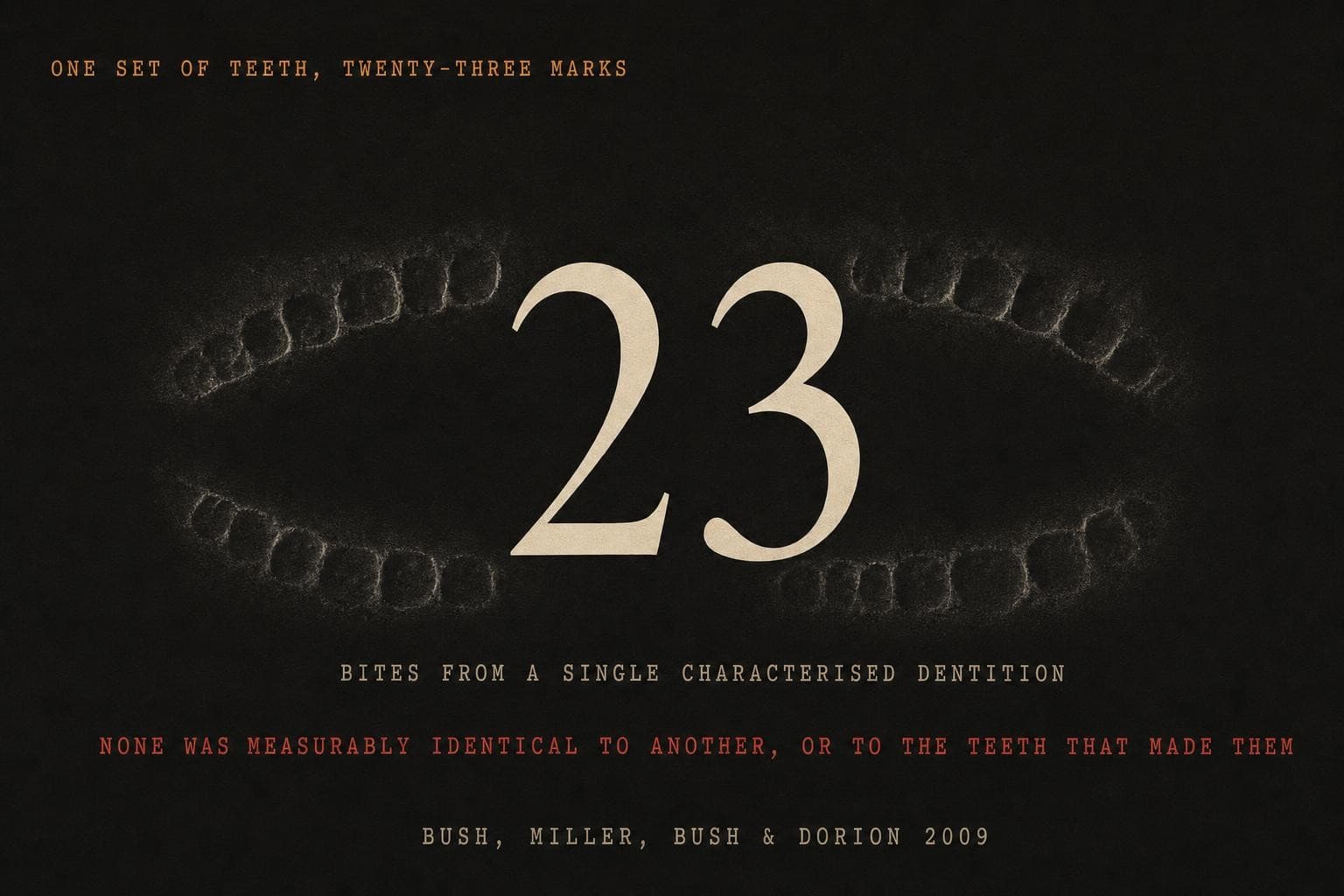
Suppose the teeth are unique. The mark is in skin, and skin is a poor medium for holding a shape. The Bush group tested this on cadavers. In "Biomechanical Factors in Human Dermal Bitemarks" (Bush, Miller, Bush and Dorion, 2009), a single characterised set of teeth made 23 bites across three cadavers, at different sites and body positions. None of the 23 was measurably identical to another, or to the teeth that made them. Tooth-rotation angles shifted by up to about 80 percent, arch widths by a quarter. The variable driving the change was not the teeth, which never changed, but the skin: its tension lines, its curvature, the tissue underneath.
What that means for identification is direct. Raymond Miller and colleagues (2009) took 100 lower dental models, confirmed each was distinct, then had ten of them bite cadaver skin and asked which of the 100 could be excluded as the source. Between 3 and 16 percent of the whole set could not be excluded from any given bite. Among dentitions with similar alignment, up to 86 percent could not be excluded. And in some cases a set of teeth that had not made the mark corresponded to it better than the set that had. That is a false identification produced under controlled conditions, with ground truth known.
The result repeats. Bush and colleagues (2011) impressed 89 marks from one dentition into cadaver skin and none corresponded to the biting teeth within measurement error. The warning is not new. Duane DeVore reported in 1971 that skin marked with an ink grid stretched by up to 60 percent as the body changed position, and that a marked area shrank by about 45 percent once excised and preserved. He concluded that a superimposition comparison is invalid unless the exact body position at the moment of the bite is known and reproduced.
Two honest qualifications belong here. DeVore also allowed that a distinctive or abnormal dentition might still be distinguishable, so the failure is not absolute. And the Bush studies used unembalmed cadaver skin, which does not bruise or swell; a living victim’s response is more likely to add distortion than to remove it. The conclusion the experiments support is narrow and firm: skin does not reliably carry the detail of the dentition, and a measurement taken from a bitten area is partly a measurement of the body and its position, not only of the teeth.
“Results showed difficulty distinguishing the biter from individuals with similarly aligned dentitions and in some cases, an incorrect biter appeared better correlated to the bite.”
What the skin kept
Your comparison depends on the mark being a faithful record. Counsel tests that.
"Your comparison assumes this mark is a faithful copy of the teeth that made it. But skin stretches and moves, and the same set of teeth can leave two different marks depending on where the body was, can’t it? So how do you know this mark preserved my client’s teeth, rather than distorting the shape of someone else’s?"
Whether examiners agree
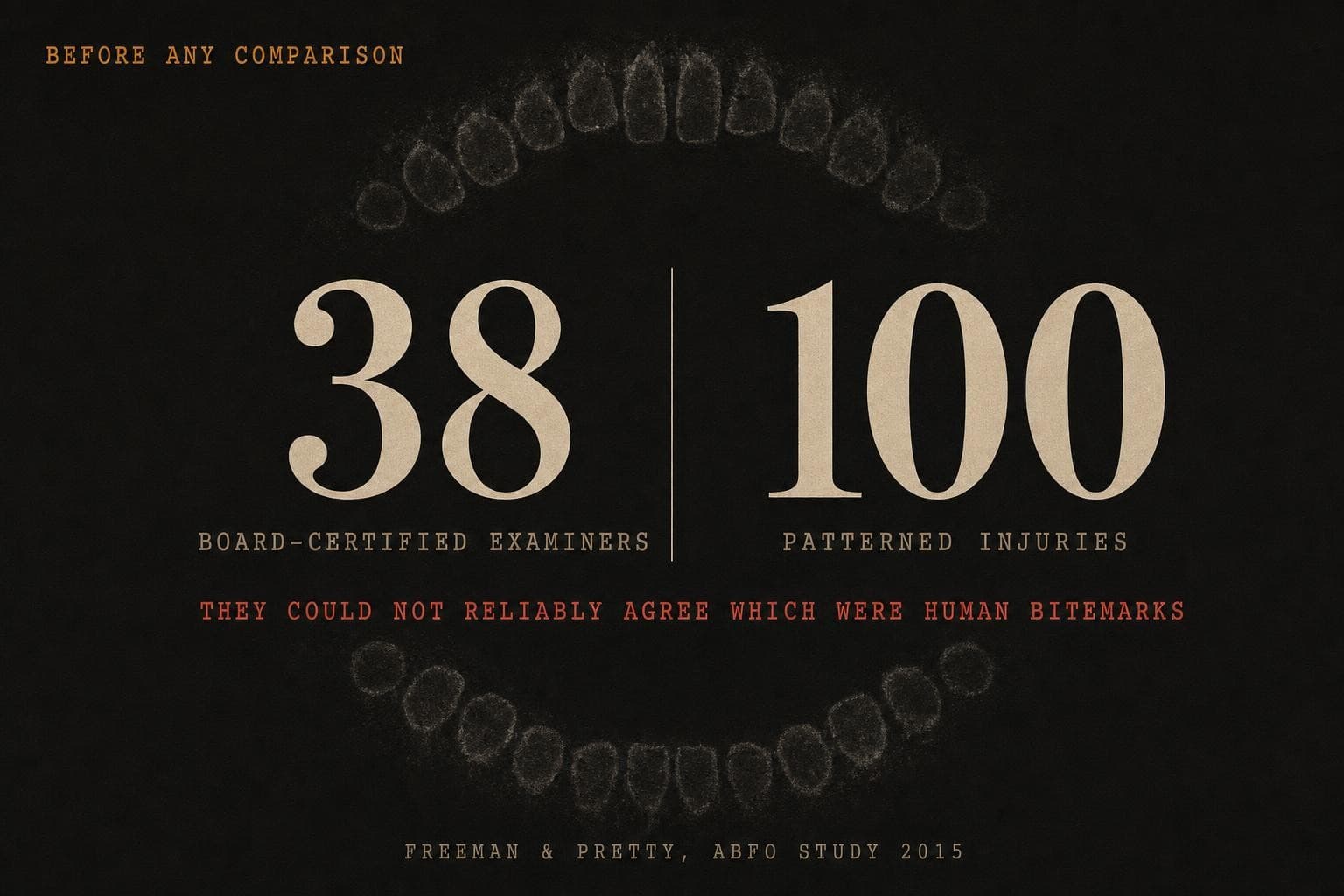
A method’s floor is whether the people using it agree, and for bite marks the disagreement starts before any comparison, at the threshold question of whether an injury is a human bite at all. Adam Freeman and Iain Pretty put that question to the American Board of Forensic Odontology in a 2015 study: 38 board-certified diplomates viewed 100 patterned injuries, with no case information, and rated each as a bitemark, suggestive of one, or not a human bite. They could not reliably agree. The study carried enough weight that the 2016 PCAST report relied on it, concluding that examiners "cannot even consistently agree on whether an injury is a human bitemark."
Mark Page, Jane Taylor and Matt Blenkin (2013) found the same pattern in Australia. Fifteen odontologists, most of the country’s active practitioners, commented on the same set of injuries; their agreement on the origin of the injury, measured by Fleiss’s kappa, was 0.015, which is barely above chance. The authors noted a revealing detail: practitioners agreed more readily when they were unsure than when they were confident.
Agreement on the comparison itself is limited, though not zero, and the fairer studies deserve their due. Kristopher Arheart and Iain Pretty (2001) had 32 diplomates work a small set of clear, higher-value cases and reached a combined accuracy, measured as area under the ROC curve, of 0.86. The authors called that "less than optimal," and found accuracy was unrelated to years of experience. Iain Pretty and David Sweet (2001) measured inter-examiner reliability on the standard overlay technique and found it only moderate, with board certification giving no advantage. And in a controlled animal-model study, Avon and colleagues (2010) found that even diplomates, as a group and individually, made critical errors, attributing a bite to a suspect who had not made it.
The honest summary is mixed rather than uniformly damning. On clear marks and pooled judgements the field can perform moderately. What it cannot do is agree reliably on the first question, whether a given injury is even a bite, and the examiner’s years of experience do not predict who gets the answer right.
“Fleiss’s kappa calculation for this data set indicates that inter-examiner agreement on origin of injury is very poor, with a kappa score of 0.015.”
Is it even a bite?
Before whose teeth, there is a prior question. Counsel asks it.
"Before you ever reached my client’s teeth, you had to decide this injury was a human bite at all. I put it to you that if I sent this photograph to a room of your board-certified colleagues, they would not all agree it is even a bitemark. They wouldn’t, would they?"
Context and the examiner
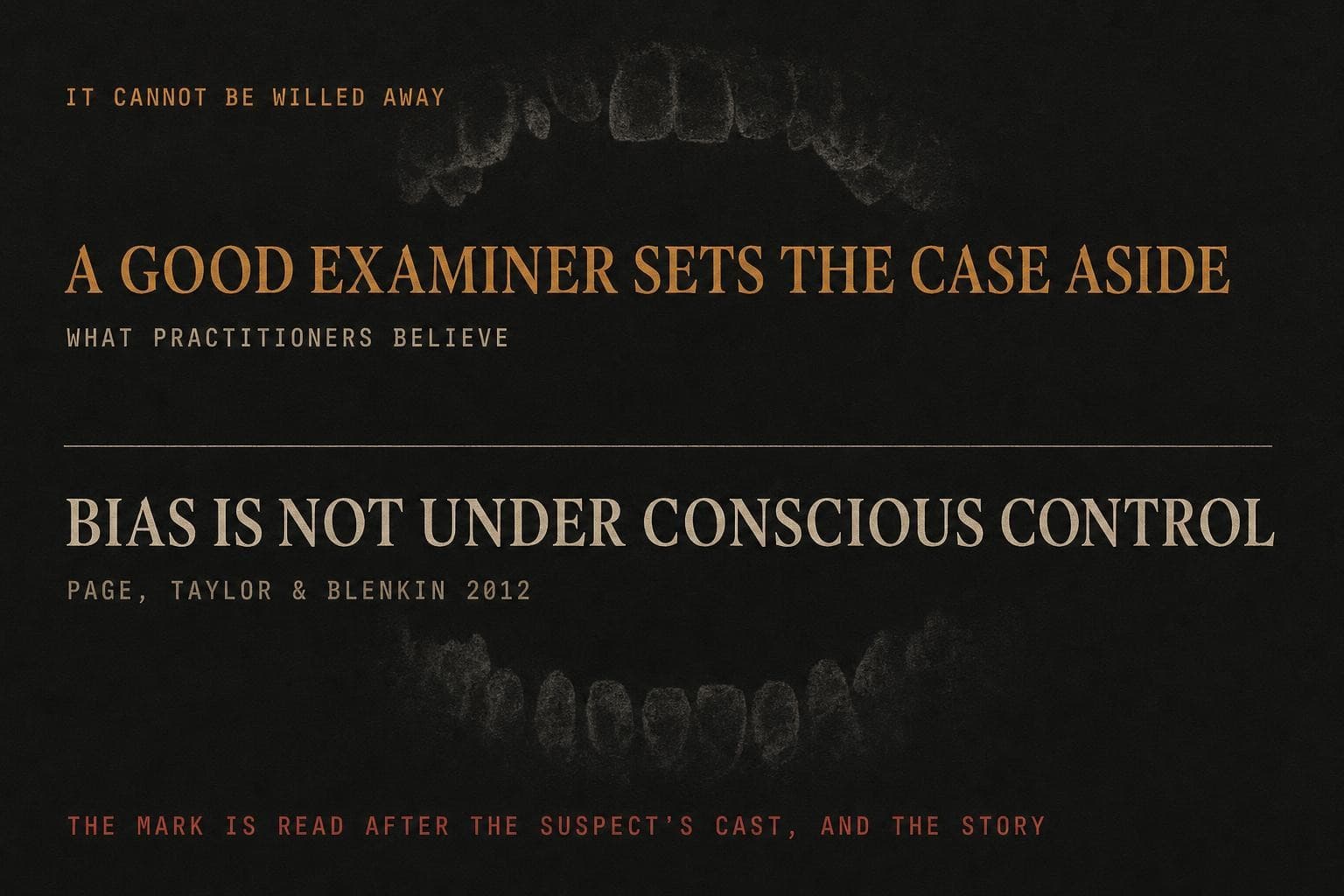
Bite-mark casework is unusually exposed to context. The injury arrives with an emotive story, often a child, a homicide or a sexual assault, and the examiner usually sees the suspect’s dental cast and knows what the police believe before forming a view on the mark. Mark Page, Jane Taylor and Matt Blenkin (2012) mapped these influences and described the practice as "rich in sources of potentially biasing influences." One they name is target-shifting: once you have studied the suspect’s teeth, you examine the mark expecting to find them. When the authors discussed cognitive bias with more than fifteen odontologists, only two could clearly define it.
Their point is not that examiners are careless. It is that the effect operates below awareness, so it cannot be corrected by resolving to stay objective.
The first empirical test came from Nikola Osborne, Sally Woods, Jules Kieser and Rachel Zajac (2014). Dental and non-dental students judged bite-mark pairs, some clear and some deliberately ambiguous, while the emotional context was manipulated. Context changed decisions only on the ambiguous pairs, and in an unexpected direction, producing fewer same-source calls rather than more. The participants were students and the marks were simulated, so the size and direction of the real-world effect remain open. But the location of the effect is the familiar one: ambiguous evidence is where context does its work, and a distorted bite mark is ambiguous evidence.
The safeguards are procedural, not attitudinal. Examine the mark and record a conclusion before seeing the suspect’s cast; release case information in sequence rather than all at once; use a second examiner who works without the case theory or the first opinion. What counts in court is whether those steps were taken, not an assurance that the examiner set the context aside. An opinion formed after absorbing the case is not independent of it.
“Cognitive bias cannot be “willed away,” as many forensic practitioners would insist is possible, because by its very nature, it is not under the conscious control of the individual.”
What you knew first
Counsel asks what you had in front of you, and when.
"When you examined this mark you already knew my client was the suspect, you had his dental cast, and you knew what the police say he did. You looked at the mark against his teeth, not against a set of strangers’ teeth, didn’t you? So how can you be sure the answer wasn’t in your mind before you compared anything?"
Say less than was once said
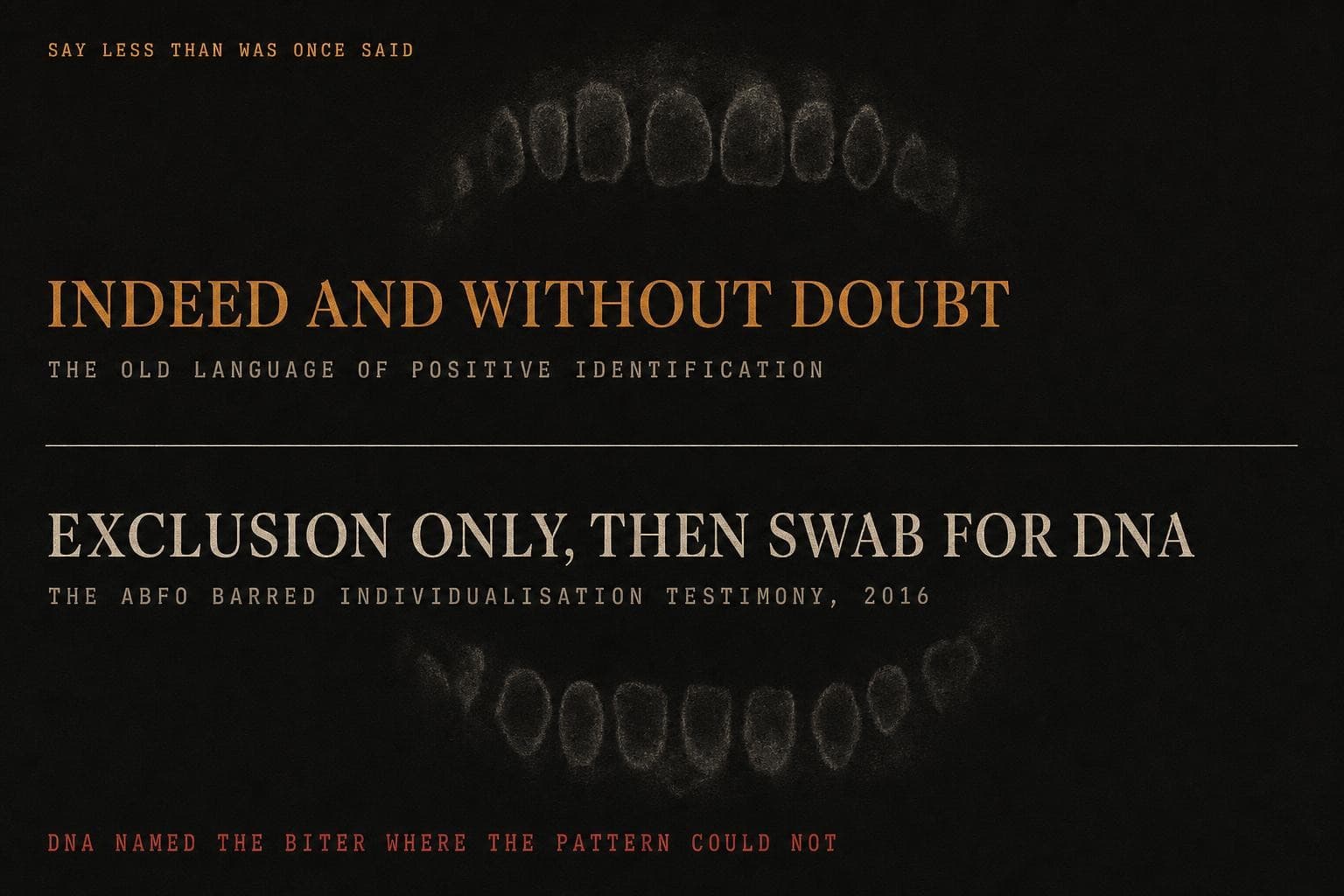
The discipline’s conclusion language has retreated, on its own initiative. For years examiners testified to positive identification, this person to the exclusion of all others, sometimes in the words "indeed and without doubt." The American Board of Forensic Odontology’s own terminology standard, quoted in the NAS report, had already disowned the strongest phrasing, and in 2016 the board went further and prohibited individualisation testimony altogether, a change Michael Bowers (2019) records from inside the field. Iain Pretty and David Sweet (2010) called the shift a change of paradigm. The discipline has also dwindled in use: a ten-year review of Australian bite-mark casework by Page, Taylor and Blenkin (2012) found 119 cases, of which only two reached trial, neither requiring an odontologist to testify.
What a bite mark can support is narrow. That a patterned injury is present, and its rough size and location. Sometimes that a particular dentition can be excluded. Rarely more than that. What it cannot support, on the evidence of the previous sections, is that one person and no other left it.
The reliable question turned out to be a different one. A bite deposits the biter’s saliva, and DNA reads it. David Sweet and colleagues (1997) recovered typable DNA from saliva left on skin; Sweet and Gary Shutler (1999) did it on a body recovered from a river, and used the profile to exclude 33 of 34 suspects, where the physical comparison could offer only "probable." By 2013 the Bush group was noting that a bite site might be better used as a source of DNA than as a pattern to compare.
The balanced view still leaves the mark a role. It can show where to swab. It can sometimes exclude a dentition, which may clear a suspect. Pretty and Sweet point out that bite marks have helped exonerate the innocent and protect children, and Franco’s work suggests a distinctive dentition in a closed group of suspects carries more information than an ordinary one. But when an identification is possible at all, the load-bearing evidence now comes from the saliva, not the shape.
“Terms assuring unconditional identification of a perpetrator, or without doubt, are not sanctioned as a final conclusion.”
Not everything an odontologist is asked to say about a bite rests on the same ground. The bars show how much settled scientific footing each kind of claim can draw on, from coarse description to the individualisation the discipline’s own board now prohibits, not a real metric.
The reliable step
You told the jury my client left this mark. Counsel opens on what you were entitled to say.
"You told this jury my client, and no one else, left this mark. Your own professional board no longer permits an odontologist to say that, does it? And if you wanted to know whose mouth made this bite, the reliable step was to swab it for saliva and test the DNA. Was that done?"
When bite marks convicted the innocent
The failures are documented, and there are many of them. Ray Krone was sentenced to death in Arizona in part on Raymond Rawson’s testimony that the marks on the victim fit his teeth; the state’s own supreme court observed that without the bite marks the state "arguably had no case," and DNA later matched a different man, Kenneth Phillips. Keith Harward was convicted on the certainty of six dentists: two testified he had bitten the victim, one "with all medical certainty," telling the jury that everyone’s teeth are "unique and individual." He had first been excluded, and the examiners revised their opinions to identification only after a senior dentist named him. DNA freed him after 33 years and matched a sailor, Jerry Crotty.
In Mississippi, Michael West told a jury that nineteen marks on a murdered three-year-old had been left "indeed and without a doubt" by Kennedy Brewer; a defence expert testified they were insect bites on a body that had been in water. DNA later cleared Brewer and, in a near-identical case two years earlier, Levon Brooks, and identified the real killer, who had been an early suspect in both.
Steven Chaney was convicted on a "one in a million" bite-mark claim that the expert, Jim Hales, later recanted in a sworn affidavit. Robert Lee Stinson lost 23 years on an identification given with "no margin for error," confirmed as a second opinion by the same Raymond Rawson who had testified against Krone, until DNA identified Moses Price. William Richards was convicted on a bite-mark opinion the odontologist, Norman Sperber, later repudiated; California then rewrote its law so that repudiated or scientifically undermined expert testimony counts as false evidence, and the conviction was vacated in 2016.
Roy Brown spent fifteen years inside on a bite-mark opinion from a local dentist with no board certification and no formal training in the analysis — after a qualified odontologist had already examined the same marks and concluded Brown could be excluded. The prosecution set that exclusion aside and commissioned the non-expert opinion that identified him. Brown obtained the buried report under freedom-of-information law, named the real biter himself, and DNA confirmed it in 2007. Pretty and Bowers, whose account this draws on, use the case to make the uncomfortable point that the correct science was available the whole time and the process discarded it.
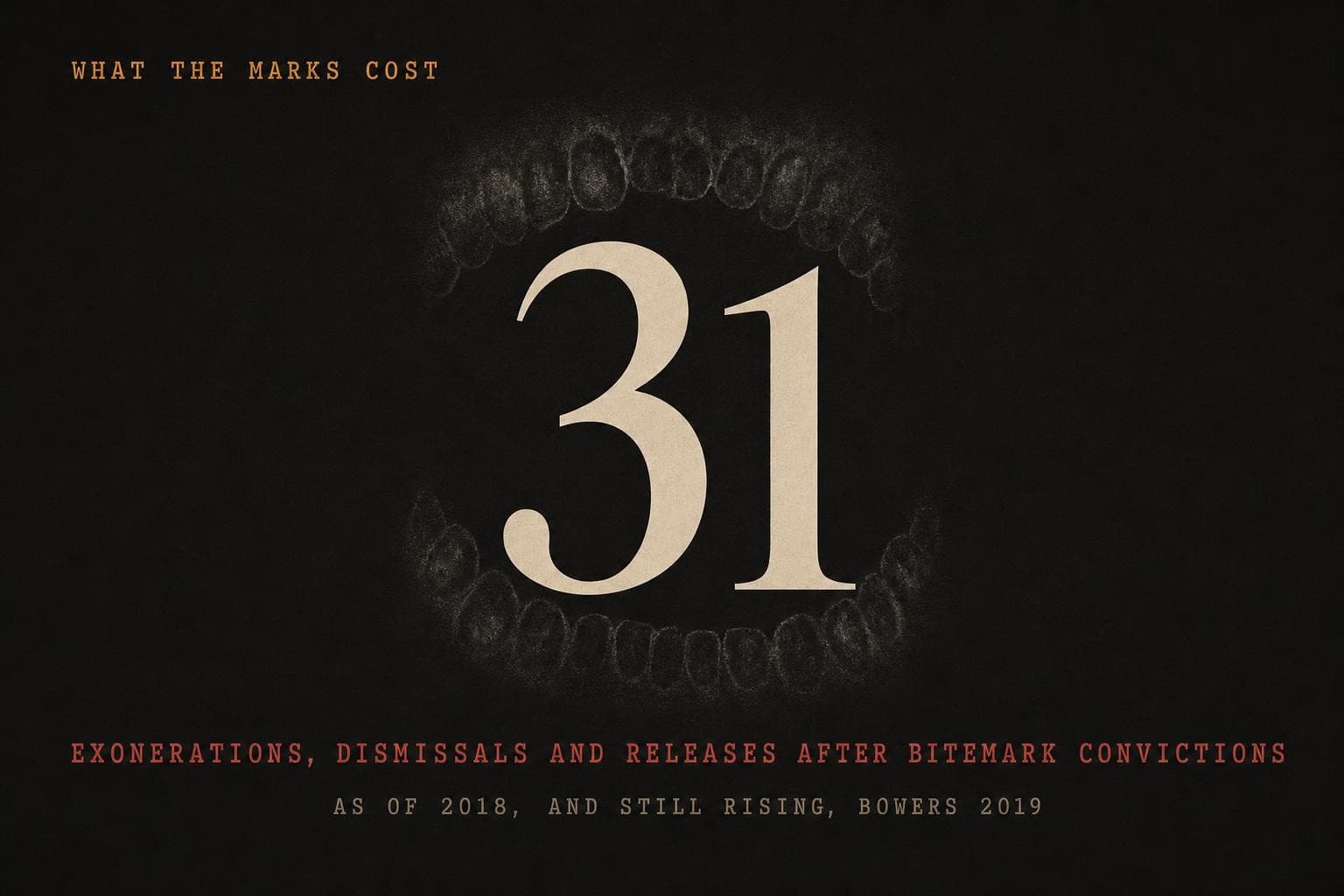
Three lessons run through the set. The correct science can be available and still discarded, as Brown’s exclusion was. Admissibility never established validity: a Mississippi court had affirmed Brooks’s conviction and, in doing so, declared bite-mark evidence admissible in the state. And the counts kept climbing. Michael Bowers (2019) recorded at least 31 exonerations, dismissals and releases tied to bite-mark evidence; by 2023 the figure cited within the field was 38. Even Michael West, the discipline’s most notorious practitioner, came to say in a sworn deposition that bite-mark analysis should be thrown out of court. The working lesson is plain: know these cases better than counsel does, say only what the mark supports, and where an identification matters, swab for DNA.
“I no longer believe in bite-mark analysis. I don’t think it should be used in court. I think you should use DNA. Throw bite marks out.”
- 01This is the discipline forensic science came closest to abandoning. PCAST advised against even trying to validate it, the 2023 NIST review found none of its premises hold, and in Australia it barely reaches court. Asked to give a bite-mark identification, the defensible position is how little it supports.
- 02Two premises hold the discipline up. The first, that everyone’s teeth are unique, has never been shown in a population, and multiplying tooth positions as if they were independent overstated the rarity. Even unique teeth would identify no one on their own.
- 03The second premise fails in the skin. One set of teeth leaves different marks at different sites and positions, and in cadaver studies the wrong dentition sometimes fit a mark better than the right one. A measurement off a bitten area is partly about the body, not the biter.
- 04Examiners cannot reliably agree on the first question, whether an injury is a human bite at all. Freeman and Pretty found board-certified diplomates split on 100 injuries; an Australian panel’s agreement on origin was barely above chance.
- 05On clear, higher-value marks the field can perform moderately, and experience does not predict who is accurate. Say where your mark sits on that range, and do not lean on your years.
- 06Bite-mark work is soaked in context: an emotive case, the police theory, the suspect’s cast seen before the mark. The bias is not a failure of will, and the guard against it is to read the mark before the cast and to use a blind second examiner.
- 07The strongest thing a bite usually offers is somewhere to swab. Salivary DNA has named biters and excluded suspects where the pattern could not, and the ABFO itself now bars individualisation testimony.
- 08People went to death row on confident bite-mark identifications that DNA overturned. Know Krone, Harward, Brewer, Brooks, Chaney, Stinson and Richards better than the barrister does, and never say more than the mark supports.
The same confidence
Counsel places your conclusion beside the cases that came before it.
"Men have gone to death row on a confident dentist’s word that a mark fit their teeth, and DNA later proved the dentist wrong and named someone else. You’re offering this jury the same kind of confidence about my client, aren’t you? What is it in your method that guarantees you are not making the very same mistake?"
Still have questions about the research?
Ask anything about the bite-mark analysis literature. The tutor answers from the document itself — and keeps one eye on how it might come up under cross-examination.
- Sauerwein, K., Butler, J. M., Reczek, K. K., & Reed, C. (2023). Bitemark Analysis: A NIST Scientific Foundation Review (NIST IR 8352). National Institute of Standards and Technology.
- National Research Council. (2009). Strengthening Forensic Science in the United States: A Path Forward. Washington, DC: The National Academies Press.
- President’s Council of Advisors on Science and Technology. (2016). Forensic Science in Criminal Courts: Ensuring Scientific Validity of Feature-Comparison Methods. Washington, DC.
- Rawson, R. D., Ommen, R. K., Kinard, G., Johnson, J., & Yfantis, A. (1984). Statistical evidence for the individuality of the human dentition. Journal of Forensic Sciences, 29(1), 245–253.
- Bush, M. A., Bush, P. J., & Sheets, H. D. (2011). Statistical evidence for the similarity of the human dentition. Journal of Forensic Sciences, 56(1), 118–123.
- Franco, A., Willems, G., Souza, P. H. C., Coucke, W., & Thevissen, P. (2017). Uniqueness of the anterior dentition three-dimensionally assessed for forensic bitemark analysis. Journal of Forensic and Legal Medicine, 46, 58–65.
- Bush, M. A., Miller, R. G., Bush, P. J., & Dorion, R. B. J. (2009). Biomechanical factors in human dermal bitemarks in a cadaver model. Journal of Forensic Sciences, 54(1), 167–172.
- Miller, R. G., Bush, P. J., Dorion, R. B. J., & Bush, M. A. (2009). Uniqueness of the dentition as impressed in human skin: a cadaver model. Journal of Forensic Sciences, 54(4), 909–914.
- Bush, M. A., Bush, P. J., & Sheets, H. D. (2011). A study of multiple bitemarks inflicted in human skin by a single dentition using geometric morphometric analysis. Forensic Science International, 211(1–3), 1–8.
- DeVore, D. T. (1971). Bite marks for identification? A preliminary report. Medicine, Science and the Law, 11(3), 144–145.
- Freeman, A. J., & Pretty, I. A. (2015). Construct validity of bitemark assessments using the ABFO bitemark decision tree. American Academy of Forensic Sciences 67th Annual Meeting, Odontology Section, G14. (Reported in the 2016 PCAST report.)
- Page, M., Taylor, J., & Blenkin, M. (2013). Expert interpretation of bitemark injuries: a contemporary qualitative study. Journal of Forensic Sciences, 58(3), 664–672.
- Arheart, K. L., & Pretty, I. A. (2001). Results of the 4th ABFO Bitemark Workshop—1999. Forensic Science International, 124(2–3), 104–111.
- Pretty, I. A., & Sweet, D. (2001). Digital bite mark overlays: an analysis of effectiveness. Journal of Forensic Sciences, 46(6), 1385–1391.
- Avon, S. L., Victor, C., Mayhall, J. T., & Wood, R. E. (2010). Error rates in bite mark analysis in an in vivo animal model. Forensic Science International, 201(1–3), 45–55.
- Page, M., Taylor, J., & Blenkin, M. (2012). Context effects and observer bias: implications for forensic odontology. Journal of Forensic Sciences, 57(1), 108–112.
- Page, M., Taylor, J., & Blenkin, M. (2012). Reality bites: a ten-year retrospective analysis of bitemark casework in Australia. Forensic Science International, 216(1–3), 82–87.
- Osborne, N. K. P., Woods, S., Kieser, J., & Zajac, R. (2014). Does contextual information bias bitemark comparisons? Science & Justice, 54(4), 267–273.
- Bowers, C. M. (2019). Review of a forensic pseudoscience: identification of criminals from bitemark patterns. Journal of Forensic and Legal Medicine, 61, 34–39.
- Pretty, I. A., & Sweet, D. (2010). A paradigm shift in the analysis of bitemarks. Forensic Science International, 201(1–3), 38–44.
- Cardoza, A. R. (2023). Forensic odontology and bite mark analysis: understanding the debate. Journal of the California Dental Association, 51(1), 2210332.
- Sweet, D., Lorente, J. A., Valenzuela, A., Lorente, M., & Villanueva, E. (1997). PCR-based DNA typing of saliva stains recovered from human skin. Journal of Forensic Sciences, 42(3), 447–451.
- Sweet, D., & Shutler, G. G. (1999). Analysis of salivary DNA evidence from a bite mark on a body submerged in water. Journal of Forensic Sciences, 44(5), 1069–1072.
- Saks, M. J., Albright, T., Bohan, T. L., Bierer, B. E., Bowers, C. M., Bush, M. A., Bush, P. J., et al. (2016). Forensic bitemark identification: weak foundations, exaggerated claims. Journal of Law and the Biosciences, 3(3), 538–575.
- Texas Forensic Science Commission. (2016). Forensic bitemark comparison complaint filed by the Innocence Project of Texas: final report.
Counsel is briefed on this literature. Take it into the witness box and practise bite-mark comparison.