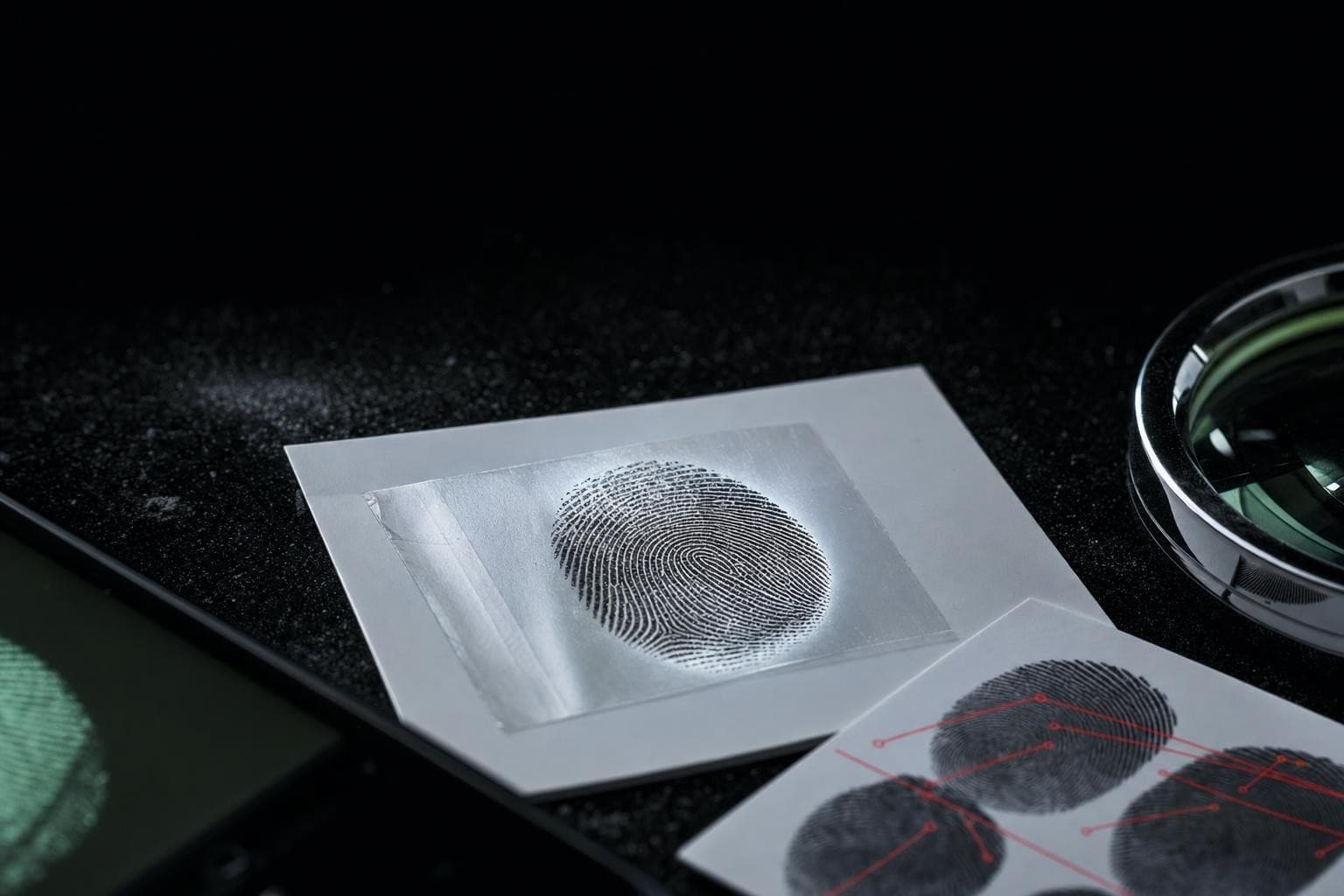
Latent Fingerprint Examination: The Discipline That Argues With Itself
For a century fingerprint identification was the model of forensic certainty: unique, permanent, infallible, a zero error rate. Then the field measured itself. Eight sections trace what its own research now shows: there is no objective threshold for a match, ACE-V is a description rather than a tested method, examiners disagree with each other and with themselves, context can flip a conclusion, and the words "identification" and "to the exclusion of all others" claim far more than the evidence can carry. The strong core is real. The overstatement around it is where cases go wrong.
The claim with no number behind it
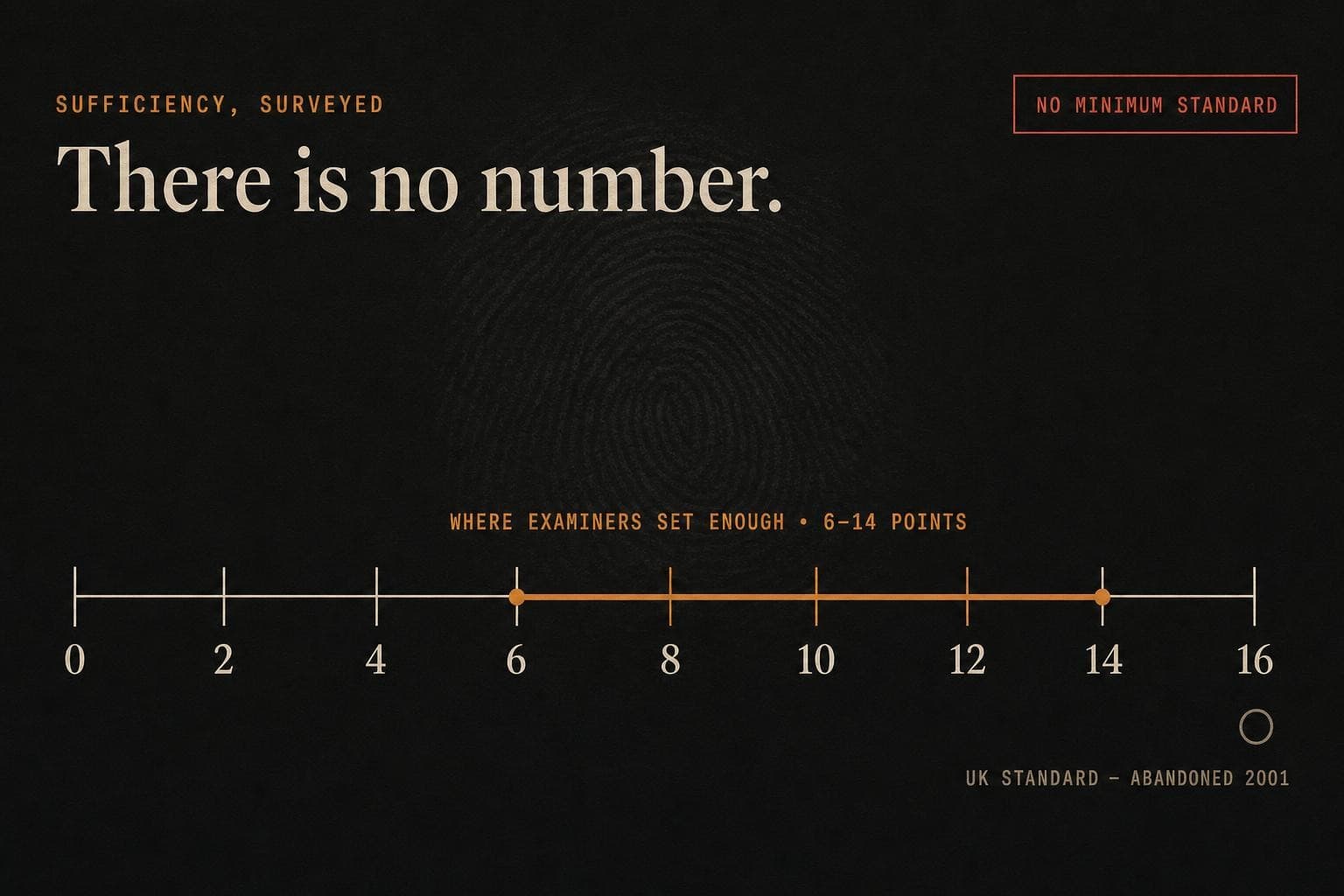
Ask a fingerprint examiner how many matching features it takes to declare an identification, and the honest answer is that there is no number. The United States abandoned any minimum point standard in 1973, and the international Ne'urim declaration of 1995 confirmed it: no scientific basis exists for requiring a set count of corresponding ridge features to establish an identification. What replaced the number was the examiner's training and experience. As Simon Cole traces it, the discipline's own founders knew the criteria were, in Stoney's words, subjective and ill-defined, the products of probabilistic intuitions widely shared among examiners, not of scientific research.
That missing threshold is not a historical footnote. When Bradford Ulery and colleagues at the FBI and Noblis actually measured where examiners draw the line, they found no shared line at all. More than a third of examiners would individualize on eight or fewer corresponding minutiae; others held out for as many as fourteen. Handing examiners a twelve-point standard did not even change how often they individualized, sixty-nine per cent for the twelve-point group against sixty-two for the rest. What the jury hears as a fact of nature is, in the authors' words, the examiner's determination, not an objective metric.
Underneath the threshold sits the premise the whole discipline is built on: that fingerprints are unique, and that uniqueness lets an examiner attribute a mark to one person and no one else on Earth. The premise has never been established. David Kaye, dissecting the government's flagship fifty-thousand-print study, showed it could not prove what it claimed, because it compared prints to themselves rather than testing whether two different fingers can leave marks an examiner cannot tell apart. On the study's own accidental duplicates, two rollings of the same finger scored as similar as two different fingers about one time in three thousand. Push that across a planet of fingers and the chance of a coincidental look-alike stops being astronomical.
The newer work sharpens the point. Building on artificial-intelligence analyses of print similarity, Gold and Cuellar estimate a fifty per cent chance of a coincidental match once a database reaches roughly fourteen million people, approaching certainty by forty million, the population of a large city. Even the classic engineering models concede the ground: Pankanti and colleagues, quantifying fingerprint individuality, concluded that contrary to popular belief, matching is not infallible and leads to some false associations. And permanence, the other half of the premise, is softer than advertised. Anil Jain's fifteen-thousand-subject longitudinal study found match scores decline measurably as the years between prints grow.
“The problem is that the supposed law of nature is an article of faith rather than a scientifically supported conclusion.”
None of this means fingerprints are worthless, and an honest witness should not pretend it does. A clear latent with ample ridge detail, compared to a good exemplar, is powerful evidence, and examiners are genuinely skilled at it. The point is narrower and harder to wave away. The identification rests on a premise that was assumed rather than proved, and it is delivered without the one thing that would make it objective: a stated, validated amount of agreement that separates a match from a non-match. When an examiner testifies that two prints match, the jury should know there is no measured line the examiner crossed to say so. There is a judgement, made by a person, that this was enough.
How much is enough?
You have told the jury the crime-scene latent and the accused's print are an identification.
"Before you reached that conclusion, was there a minimum number of corresponding features you were required to find, a line fixed by science that separates a match from a non-match? Or is the truth that how much agreement is 'enough' was, in the end, your own judgement?"
ACE-V: a method, or a name for it?
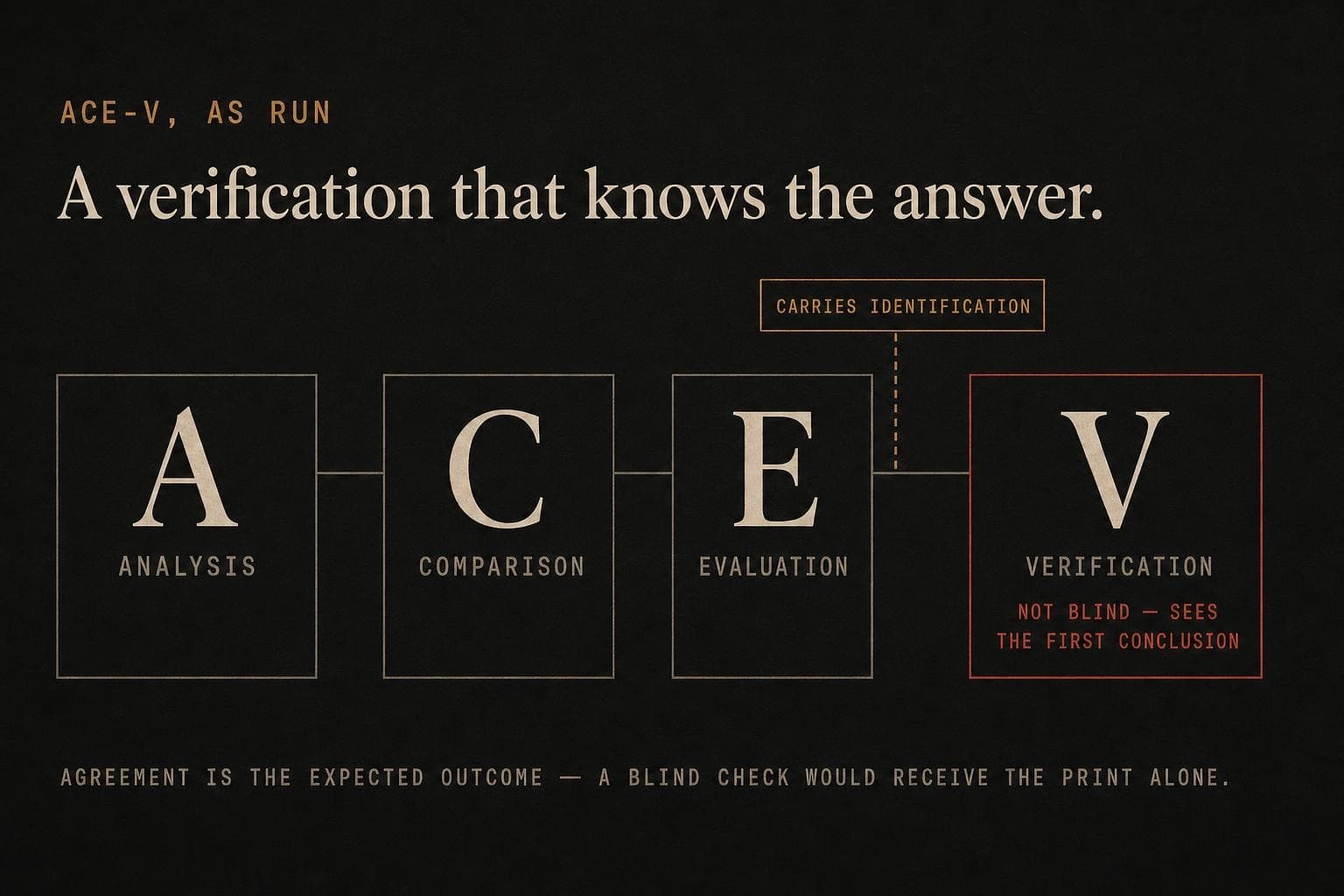
In court the discipline's method has a name: ACE-V, for Analysis, Comparison, Evaluation and Verification. It sounds like a protocol, and it is offered as the reason the work is scientific. Look closely and it is a description of the order in which an examiner does things, not a procedure with rules, thresholds, or a measured error rate. The statistician Sandy Zabell called it an acronym, not a methodology. Joseph Kadane, reviewing it, wrote that it is more an outline than a scientific method: two analysts can perform different activities, and arrive at different conclusions, while both can claim to be using the ACE-V methodology.
Ralph and Lyn Haber put the challenge at its sharpest. To validate ACE-V you would run skilled examiners through many latent-and-exemplar pairs of known ground truth, documenting each step, and measure how often the method's conclusions match the truth. That experiment, they note, has never been offered as evidence in any of the Daubert hearings, nor has one ever been published. Resemblance to the scientific method is not evidence of accuracy. It is, in their words, an analogy and nothing more.
The defences of ACE-V tend to be circular, and the field's own literature shows it. Cole catalogues the moves: the method is valid because courts and practitioners have accepted it for a hundred years, and the errors that do surface are blamed, after the fact, on incompetent analysts. One widely cited practitioner paper defends it by saying ACE-V is a valid scientific method if it is used as a valid scientific method. The trouble with blaming incompetence is Madrid. The three FBI examiners who agreed on the erroneous Brandon Mayfield identification were among the most senior, most experienced and most trained at the Bureau. Whatever failed there, it was not a junior examiner cutting corners.
The fourth letter deserves particular attention, because juries hear verification as independent confirmation. Usually it is not. In routine practice the verifier already knows the first examiner reached an identification, and is often asked to check only the identifications. Kadane's verdict is blunt: when the verifier knows the outcome of the original analysis, the independence of the verification is impugned. A second examiner who shares the first one's expectation is not a fresh test. As later sections show, examiners can be led to reverse even their own past conclusions, so a confirmation that is not blind confirms the expectation as easily as the truth.
“the ACE-V method currently is both untested and untestable.”
There is a constructive alternative, and it matters because it shows the categorical claim is a choice rather than a necessity. Christophe Champod, Cedric Neumann and colleagues have built likelihood-ratio models that ask a different question: not is this the source, yes or no, but how much more probable is this degree of agreement if the prints share a source than if they do not. On that scale, exclusion and individualization are simply the two endpoints, a likelihood ratio of zero and of infinity, with everything real sitting in between as a weight of evidence. The honest reading of most casework is a strength, not a certainty. ACE-V, as practised, collapses that continuum into three boxes and hands the jury the most extreme one.
Is verification a second test?
You told the jury your identification was verified by a second qualified examiner.
"When your colleague verified your work, did they come to it blind, not knowing what you had concluded? Or did they already know you had declared an identification, and were checking whether they agreed with it?"
The black box opens
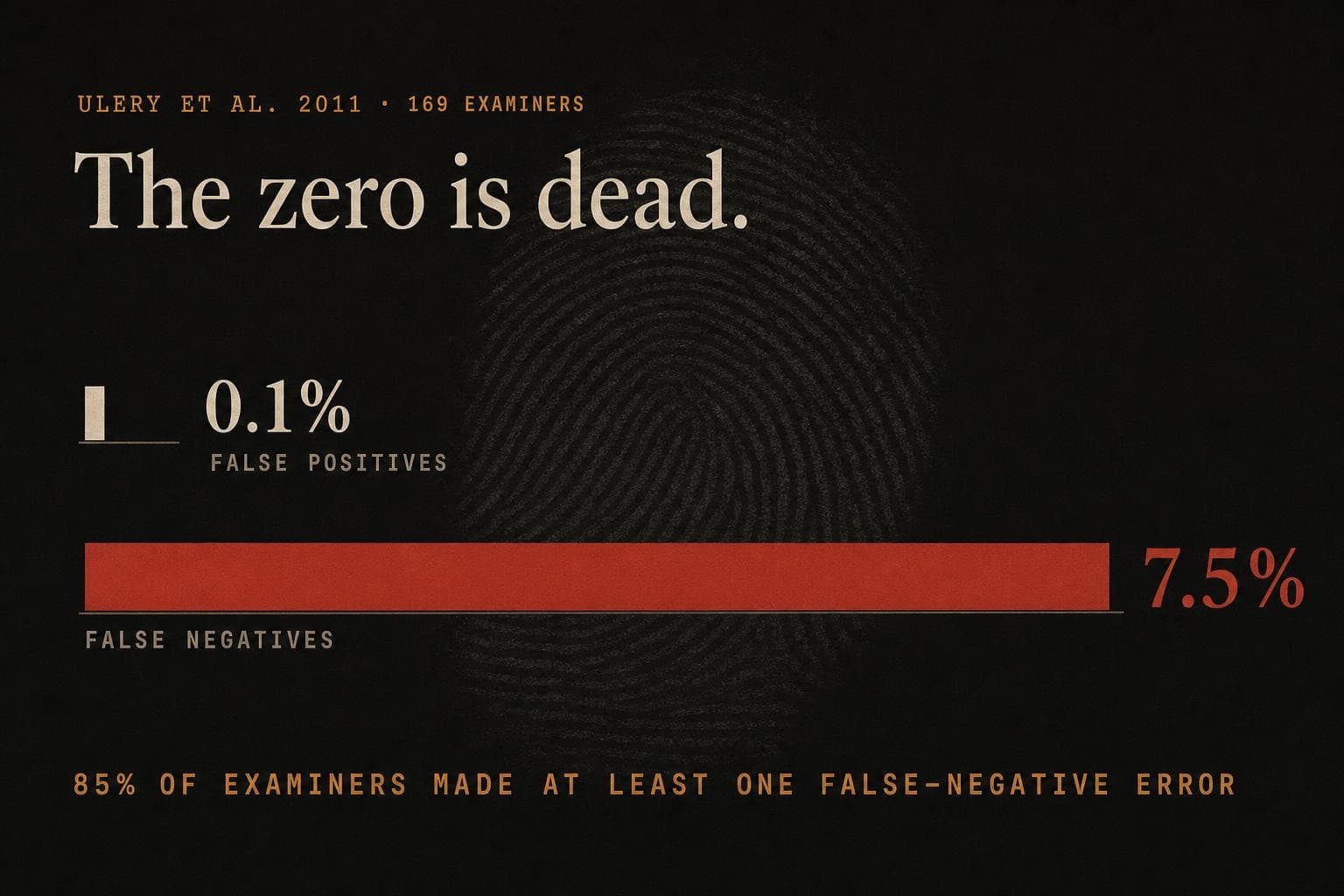
For most of its history the field claimed an error rate of zero. In 2011 it finally measured itself. Bradford Ulery and colleagues ran 169 experienced examiners through thousands of comparisons of known ground truth, the study the discipline had never done, funded by the FBI's own laboratory. The results are now the single most important fingerprint numbers in any courtroom. Six false positives occurred, an overall false-positive rate of about one in a thousand. But false negatives, missed identifications, ran at seven and a half per cent, and eighty-five per cent of examiners made at least one. The reassuring headline and the uncomfortable one live in the same study: false positives are rare, and yet error is entirely ordinary.
A year later the same group asked whether examiners even agree with themselves. They gave 72 of the original examiners the same prints again, months later, without saying they had seen them before. Examiners repeated only about ninety per cent of their own individualizations and exclusions. Roughly one decision in ten changed. If the same expert, on the same prints, reaches a different answer on a different day, then the confident, unqualified match delivered from the stand describes the examiner's state on one occasion, not a fixed property of the prints.
The right lesson is not that fingerprinting is unreliable. It is that there is no single error rate to recite, and any number offered as the error rate is being misused. Jason Tangen and Matthew Thompson, whose own experiments found qualified examiners far more accurate than novices, warned in print that inferring the error rate of fingerprint identification is 0.68 per cent from their data would be unjustified. Their study measured the gap between experts and beginners under artificial conditions, not the rate at which real casework goes wrong. Jonathan Koehler makes the general point: there are several different error rates, false positive, false negative, false discovery, and none of them lay claim to being the error rate.
And the measured numbers are best-case. Proficiency tests, Koehler notes, are non-blind and relatively easy, so their low error rates are a floor, not a ceiling. Examiners in the black-box studies knew they were being tested. The 2025 follow-up by Hicklin and colleagues, run on the harder candidates that modern database searches throw up, is a useful caution against treating any figure as gospel: a single outlier examiner made the majority of the study's false positives, which is exactly why point estimates for rare events are fragile. The zero-error-rate claim is dead. What replaced it is not a comforting small number but a range, heavily dependent on conditions, with the individual examiner as the largest source of variation.
“False negatives were much more prevalent than false positives”
Koehler closes the last escape hatch. Examiners sometimes concede a human error rate but insist the method itself has an error rate of zero, that mistakes are the analyst's, not ACE-V's. The distinction does not survive contact with how the work is done. The method has no existence apart from the person applying judgement at every step, choosing features, deciding sufficiency, calling the conclusion. As Koehler puts it, the method literally is the people who employ it. There is no clean machine underneath the examiner to which a zero could honestly attach.
The zero that was not
On direct you agreed fingerprint identification is extremely reliable.
"Your discipline told courts for decades that its error rate was zero. When it finally ran the study, examiners missed genuine matches seven and a half per cent of the time, and changed about one in ten of their own conclusions on re-testing. You would not tell this jury the error rate is zero, would you?"
It depends how you count
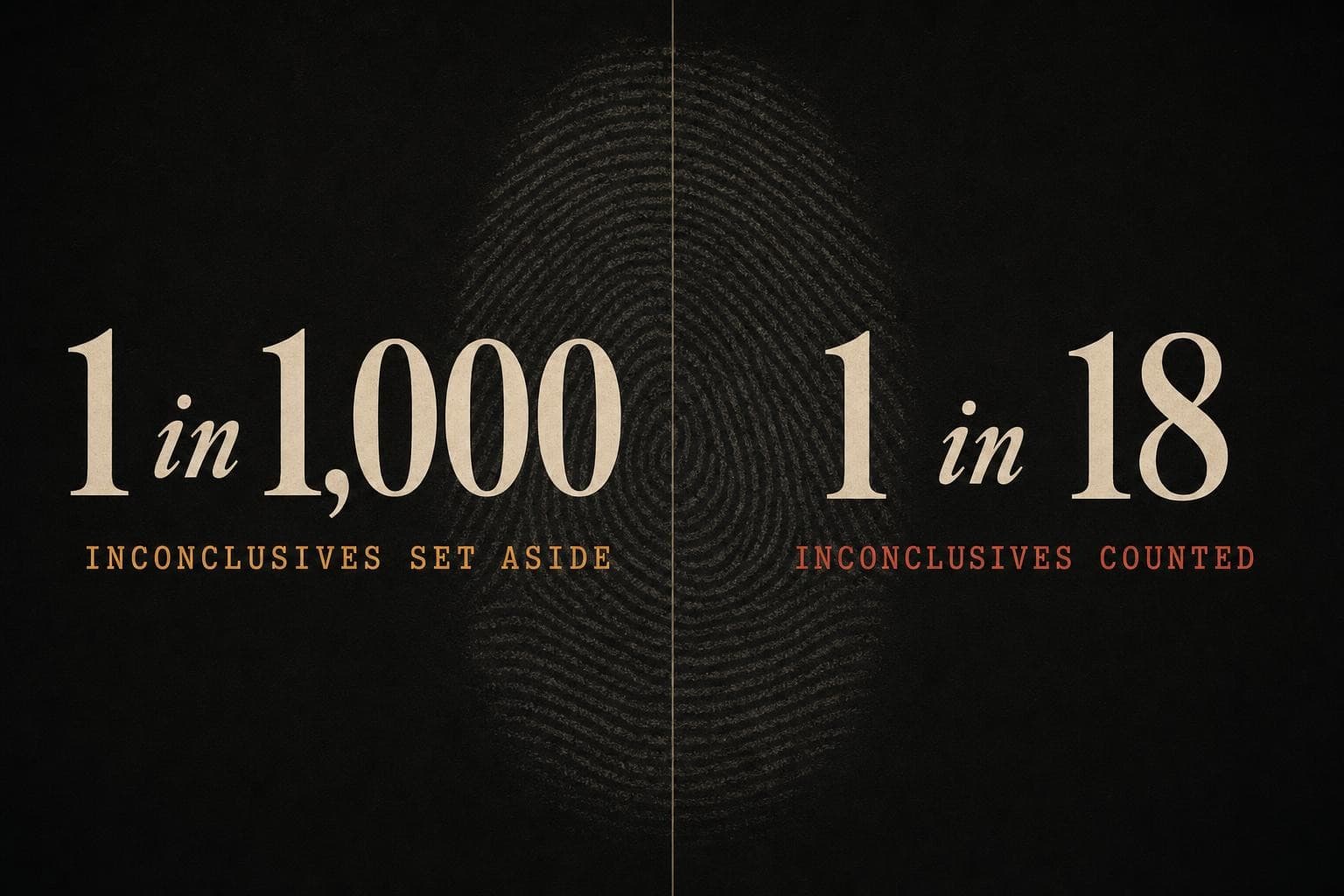
The most consequential argument in fingerprinting right now is not about ridges. It is about arithmetic, specifically what to do with inconclusive decisions. The famous one-in-a-thousand false-positive rate depends on leaving inconclusives out of the sum. When the President's Council of Advisors on Science and Technology reworked the Miami-Dade study, counting differently, it reported that false positives could occur as often as one in eighteen. Same discipline, same kind of data, a rate that moves by nearly two orders of magnitude depending on a bookkeeping choice most juries never hear discussed.
Why the choice matters so much is easy to see. If inconclusive decisions never count against an examiner, then, as Itiel Dror and Nicholas Scurich point out, an examiner could reach an inconclusive on every comparison and post a perfect score. So the denominator is doing enormous work. Reworkings of the Miami-Dade figures by Jonathan Koehler and others land anywhere from under one per cent to over four, and Madeline Ausdemore's careful re-analysis argues the highest figures overstate it. The point for a witness is not which number wins. It is that the error rate is not a fact read off the data. It is a number that depends on decisions the examiner's own field has not settled.
Two lines of work push the plausible rate up. Kori Khan and Alicia Carriquiry, modelling the missing decisions in a black-box study, found that a rate reported as low as 0.4 per cent could be at least 8.4 per cent once inconclusives are counted as correct, and over 28 per cent if they are treated as missing responses, in a study where two-thirds of the decisions were never observed. Amanda Luby and Joseph Kadane, decomposing the variance, found that treating inconclusives as errors inflates the rates at least sevenfold, and put the model-adjusted failure rate on non-matched prints at over four per cent, dozens of times the reported false-positive figure. Their plain-language objection lands hard: a one-in-a-thousand error rate, for a subjective human task, is implausibly low next to everyday benchmarks like radiology.
Honesty cuts both ways, and the section should. Hal Arkes and Jonathan Koehler argue the opposite case with a straight face: an inconclusive is not a wrong answer, because the examiner has not asserted anything about the source, and scoring it as an error punishes appropriate caution. When Koehler and Liu did push examiners toward definitive calls on deliberately close non-matches, false-positive rates climbed to 15.9 and 28.1 per cent, and Koehler himself cautions jurors not to read a close-non-match rate as the everyday casework rate. The fair summary is not that fingerprinting fails one in eighteen times. It is that the reassuring rate rests on a contested counting convention, and a witness who recites it as settled fact is overstating what the field agrees on.
“A central factor in determining an error rate is what counts as an error.”
One more wrinkle belongs here, because most modern latents arrive through a database. When a print is searched against an automated system, the computer returns a ranked list of candidates, and Itiel Dror and Kasey Wertheim showed that false identifications cluster at the top of that list, occurring even when the true match sits lower down. The ranking is a suggestion, and the suggestion biases the human. Ralph Haber, cataloguing the ways automated search introduces error, put it memorably: the technology tail is wagging the forensic dog. The candidate the machine ranked first is not the same thing as the person who left the mark.
Which number, and why
You cited a very low false-positive rate to support the strength of your identification.
"The low error rate you quoted was calculated by setting inconclusive results aside. Count them differently, as reviewers of that very data have, and the rate rises many times over. So the figure you gave the jury is not a measurement of your field's accuracy, it is one way of counting among several that are still in dispute. Correct?"
Same print, two examiners
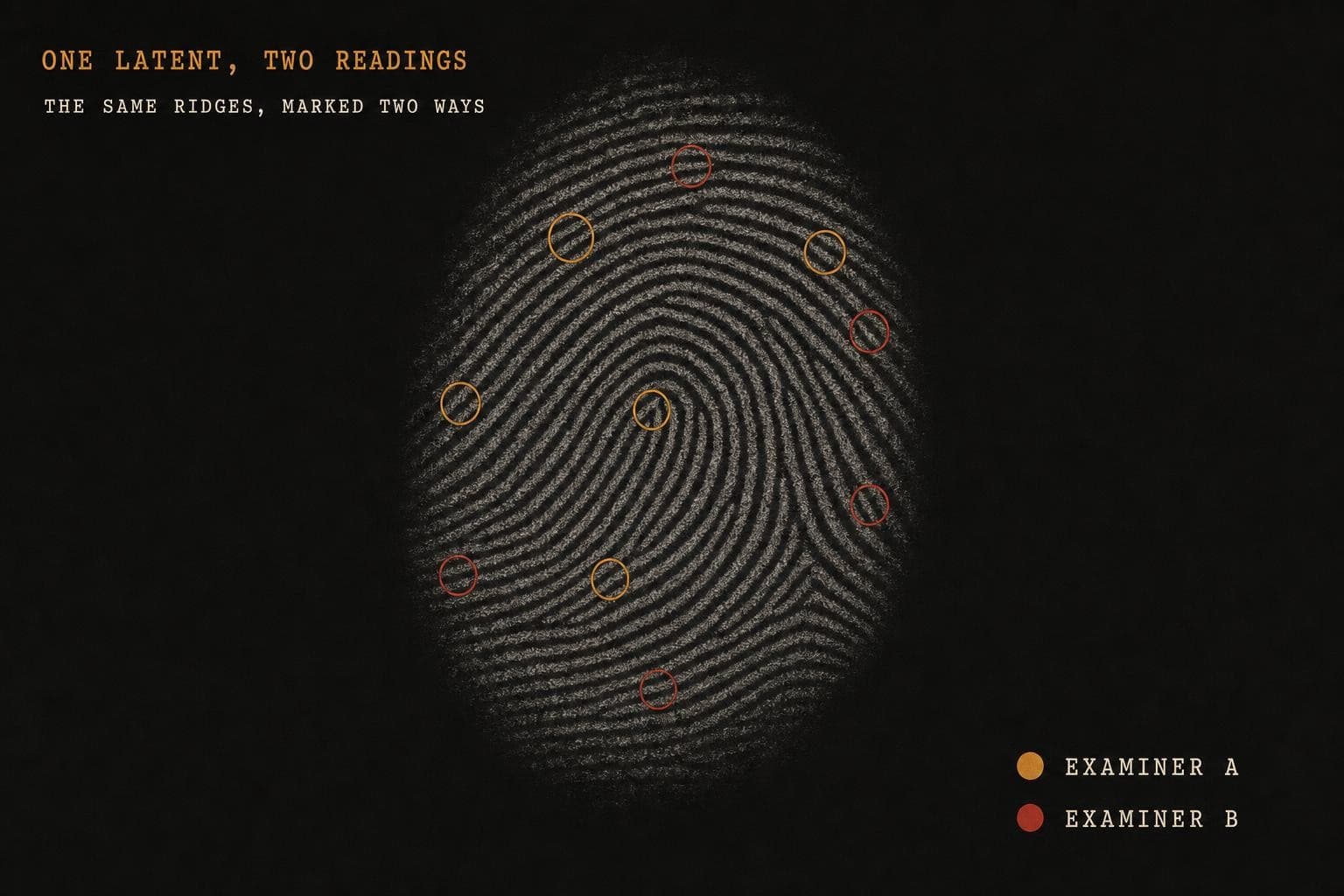
Set outright error aside and a quieter problem remains: examiners disagree, with each other and with themselves. The most revealing finding concerns what examiners do after they see the suspect's print. Ulery and colleagues had examiners mark the features of a latent during analysis, then compared that markup to what they relied on during comparison. On more than ninety per cent of individualizations, examiners added or deleted minutiae once the exemplar was in front of them, and every examiner revised at least some markups. Even when an identification rested on eight or fewer corresponding features, in most cases some of those features had not been marked until after the suspect's print appeared.
That is the textbook shape of circular reasoning: the answer you are testing against reshapes the evidence you test it with. It is not a hypothetical. In the Madrid misidentification, the initial examiner reinterpreted five of the original seven analysis points once Mayfield's exemplar was in view. And it changes conclusions wholesale. When examiners were required to mark features against the exemplar, prints they would otherwise have called not good enough to identify became identifications far more often, twenty-six per cent of the time against under two per cent when no markup was required. The exemplar does not just confirm the latent. It can manufacture the correspondence.
Even the raw materials of a comparison turn out to be unstable. Examiners with the same conclusion often reach it from different features: Ulery's markup studies found that examiners' markups may have similar minutia counts but differ greatly in which specific minutiae were marked, and in unclear areas they agreed on a given feature less than half the time. They do not even agree on whether a mark is worth comparing. As the value study put it, one examiner's no-value print may be another's identification, and Heidi Eldridge's work found there was not a single latent in her set that every examiner agreed was of no value. They disagree, too, on how rare a feature is, and therefore how much it is worth, which is the currency the whole comparison trades in.
Austin Hicklin and colleagues tied the pattern to its root. The disagreement, they wrote, reflects implicit individual decision thresholds, which they showed are measurable and differ substantially between examiners. Some examiners simply require more before they will call a match, and a few carry far higher error rates than the rest. Their conclusion is the one every cross-examiner should hold on to. Examiners are often unaware of it in themselves: nearly three-quarters of those who believed they had never made an erroneous exclusion had made at least one on a single test. And the recent work of Aggadi and colleagues links where an examiner sets that private threshold to personality and workplace stress, not to any published standard.
“aggregate error rates of many examiners are not necessarily representative of individual examiners”
This is why the field-average error rate, whichever one you accept from the last two sections, does not tell you about the examiner in the witness box. The studies measure a population; the conclusion in this case came from one person, with one private threshold, on one day, using features they may have marked only after they saw whom they were looking for. Philip Kellman's work shows the same latent can be misjudged by nine examiners in ten when it is genuinely difficult, so error is a property of the print pair as much as the person. A defensible identification survives all of this. But the jury deserves to know that same print, two examiners can mean two different answers, and that same print, same examiner can mean two different answers on two different days.
Marked before, or after?
Your identification relied on a set of corresponding ridge features.
"The features you say correspond between these two prints, how many of them had you marked on the crime-scene latent before you ever looked at the defendant's print? Or did some of them come into view only once you had his exemplar beside you to compare against?"
The examiner is human
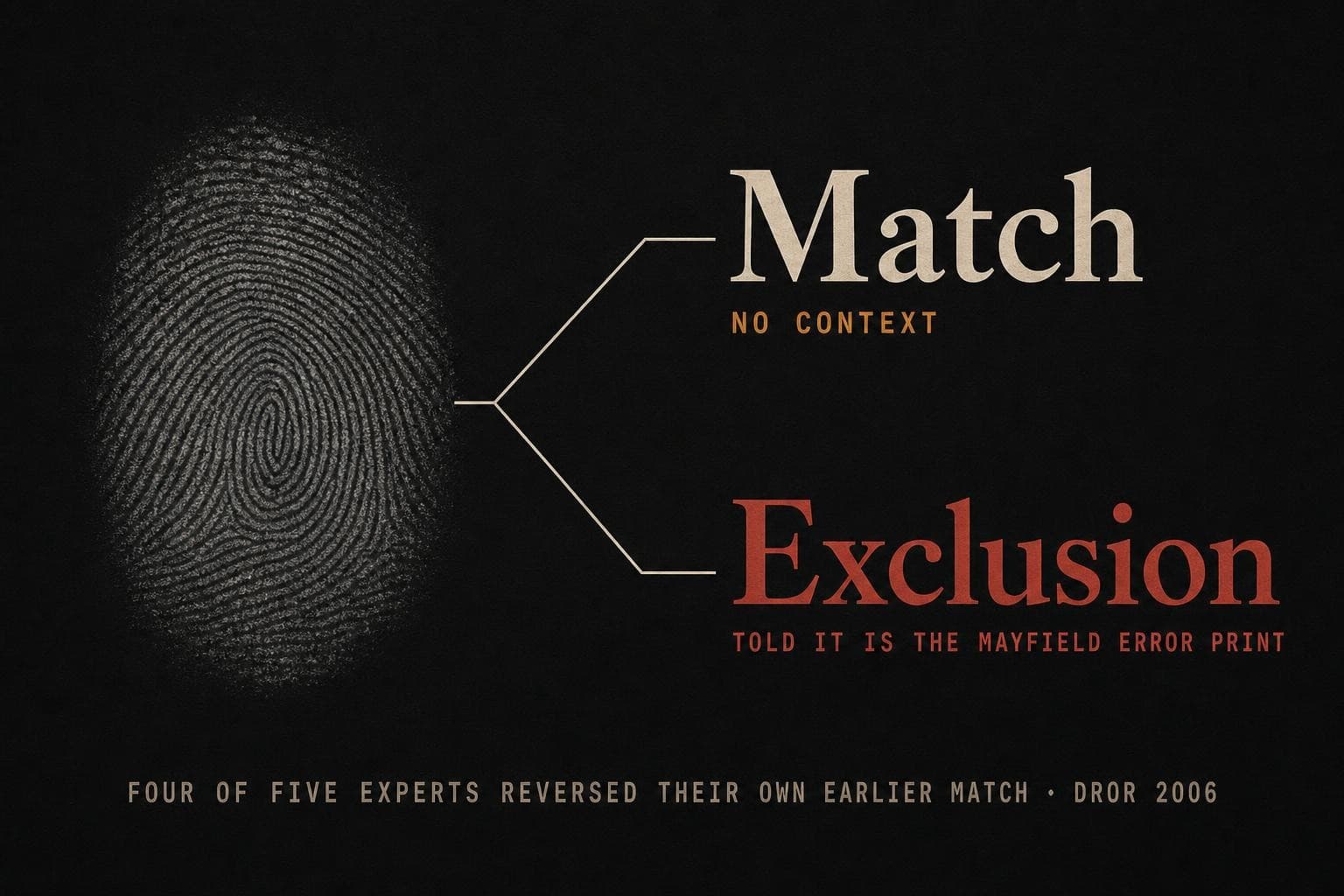
In 2006 Itiel Dror ran an experiment that should be on the syllabus of every forensic discipline. He took five experienced examiners and gave each a pair of prints they themselves had identified as a match in real casework years earlier. This time he told them the prints were the ones the FBI had wrongly matched to Brandon Mayfield. Four of the five reversed their own earlier conclusion, now calling the prints a non-match or insufficient. The ridges had not changed. Only the context had. A follow-up with subtler cues, a suspect confessed, a suspect was in custody, flipped two-thirds of examiners on at least one decision. The prints were fixed; the answers moved with the story attached.
The mechanism is not stupidity or corruption. It is how expert perception works, and it enters everywhere. A suggested target print changes which features an examiner marks in the latent. Being told a suspect confessed, or that a DNA test already implicated him, shifts the fingerprint call, as Stevenage and colleagues showed for a DNA result specifically. Bias even reaches the earliest, most innocent-looking decision, whether a mark is suitable to compare at all: Fraser-Mackenzie and colleagues found a non-matching exemplar made examiners markedly more willing to call a borderline latent suitable. The context does not wait until the end to tip the scale. It is present from the first glance.
The field's response has too often been denial, and that denial is itself a finding. When Jeff Kukucka and colleagues surveyed 403 examiners across the world, most acknowledged that cognitive bias is a real problem for forensic science as a whole, but far fewer thought it touched their own domain, and only about a quarter thought it could affect their own judgements. Thirty-seven per cent rated their own accuracy at a flat one hundred per cent. And seventy-one per cent believed examiners can defeat bias simply by trying to set their expectations aside, which is precisely the willpower fallacy the science rules out. You cannot introspect your way out of an effect you cannot feel operating.
Honesty requires the other half of the picture. The bias effect is real but it is not destiny, and it concentrates on ambiguous, difficult prints rather than clear ones. Glenn Langenburg found that when experts were pushed by context they tended to become more cautious, not more wrong. And in the most courtroom-realistic test to date, Michelle Pena and colleagues ran qualified examiners on genuine prints under blind and non-blind conditions and found no measurable bias effect, with the experts far outperforming students on fingerprints specifically. The claim to make on the stand is not that context always produces a wrong answer. It is that context demonstrably can move a conclusion, especially a hard one, and that good practice manages it rather than trusting the examiner to rise above it.
“it is possible to alter identification decisions on the same fingerprint, solely by presenting it in a different context.”
Because the effect is real, the field has built a defence against it, which means a witness can be asked whether they used it. Linear Sequential Unmasking, developed by Dror, William Thompson and colleagues and later expanded for casework by Quigley-McBride and colleagues, sets out the discipline. Analyse and document the crime-scene mark in isolation first, before you are shown the suspect's exemplar, and limit what you are allowed to revise afterward, so the reference cannot quietly reshape the latent. The logic runs from evidence to suspect, never the other way. If an examiner worked the latent side by side with the suspect's print, was told the back-story before they finished, or verified a colleague's call knowing the answer, they skipped the safeguard the field itself designed. The question is not whether they are honest. It is whether the procedure protected the honesty.
What did you know first?
You examined the latent knowing the accused was the police suspect.
"Before you finished analysing the crime-scene mark, what did you already know about the case, that there was a suspect, that he had a record, that other evidence pointed to him? And did you complete and document your analysis of that mark before you were shown his fingerprint, or with his print already in front of you?"
The word "identification"
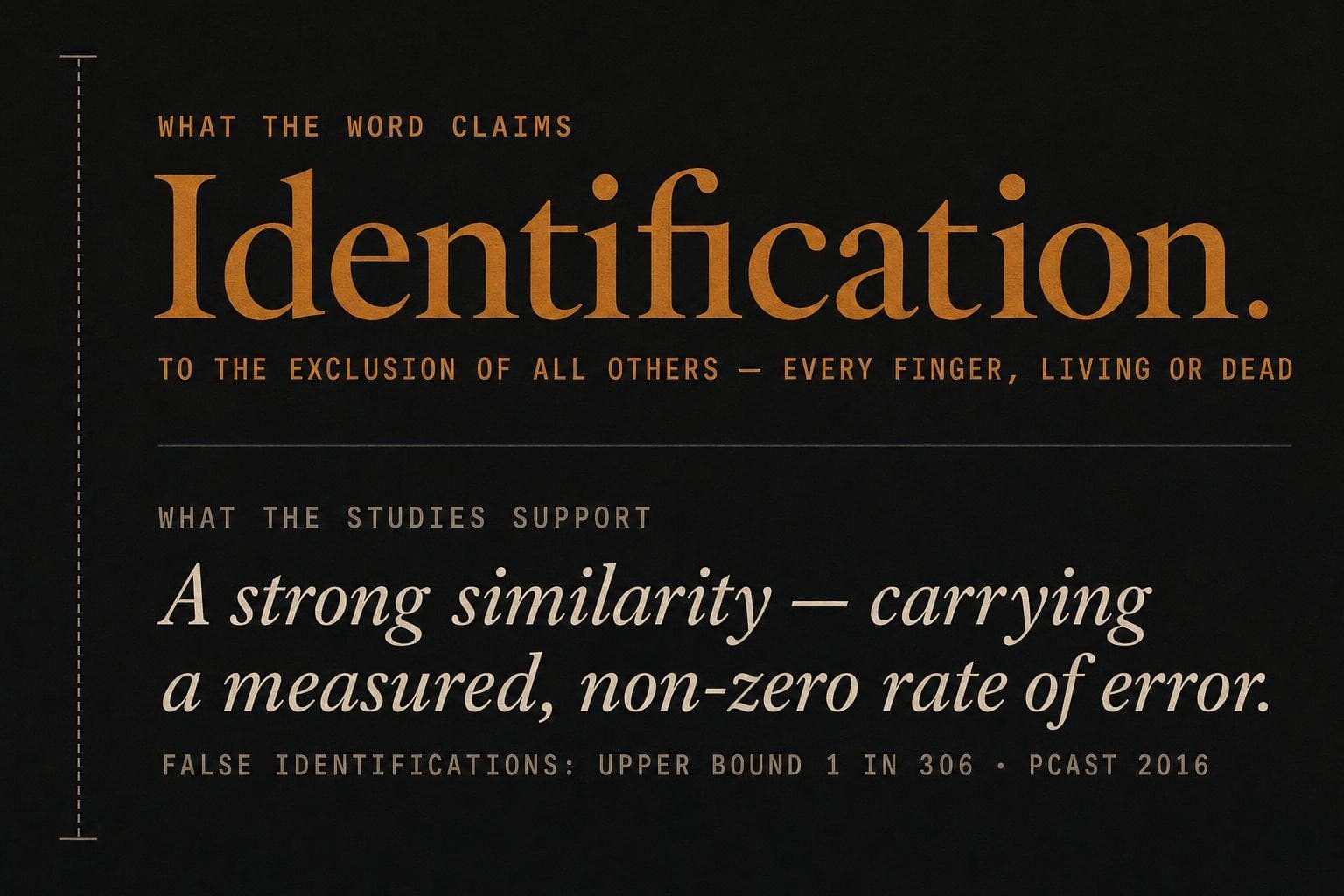
Everything in the previous sections converges on a single word. When an examiner testifies to an identification, or an individualization, or in the newer official language a source identification, the claim is that this mark was left by this person and by no one else on Earth. Christophe Champod's objection is arithmetic, not rhetorical. To exclude everyone alive, the evidence would need a likelihood ratio somewhere above ten to the thirteenth power, and, he writes, that is out of reach of current systematic research. The best validated fingerprint statistics reach something like one in a billion. Between one in a billion and everyone on the planet lies a claim the science cannot cover, and the word quietly makes it anyway.
The field knows this, and its reforms have mostly renamed the claim rather than retired it. After the National Academy of Sciences said in 2009 that no discipline but DNA could support individualization, the profession dropped the phrase to the exclusion of all others, relabelled individualization as identification, and added softer words like practical impossibility. Simon Cole's verdict is that these changes are logically empty. As the critique of the Department of Justice's approved language puts it, there is no logical difference between saying the defendant is the source of the print and saying it to the exclusion of all others; the official conclusion still rounds an admitted, non-zero probability down to a statement of certainty for the jury to hear.
It matters because of what the word does to a jury, which has now been measured. Brandon Garrett and Gregory Mitchell found that jurors weigh a bare categorical match as heavily as a strong statistical statement, and barely distinguish between match probabilities that differ by many orders of magnitude; simply adding fingerprint evidence to a case pushed their sample's conviction rate from twenty-two per cent to fifty-four. Joseph Kadane and Jonathan Koehler found jurors give still more weight when the examiner says he knows or believes the defendant is the source, and, strikingly, that cross-examination designed to highlight the weaknesses had no measurable effect on its own. The extra words of certainty add nothing the science supports and much that the jury feels.
There is one lever that works, and it points to how the honest version should sound. The same studies found that when an examiner acknowledges the possibility of error, jurors appropriately discount the evidence, and that when they are told the examiner's actual proficiency, rather than left to assume it is near perfect, their weight adjusts. Converting examiners' own conclusions into likelihood ratios, Busey and colleagues found the real strength modest next to what the categorical language implies. The reform Champod and Neumann urge is not to weaken fingerprint evidence but to state it as what it is: a weight of evidence, sometimes a very strong one, offered as an opinion, with its limits and its error attached, and the ultimate question left to the court.
“There is no scientific basis for the individualization claims in forensic sciences”
Fingerprint testimony fails most often in the conclusion language. Each phrase below claims more than any comparison can support; the alternative states the strength honestly, as an opinion with its limits attached, and leaves guilt to the court.
Exclusion of whom?
You told the jury the prints are an identification of the accused.
"When you say 'identification', you are telling this jury that this mark was left by the defendant and by no other person on Earth. You did not compare his print to everyone on Earth. So is that word a description of what you did, or a claim that reaches far beyond it?"
When it broke, and how to say it honestly
The abstractions have names. In 2004 a bomb on a Madrid commuter train left a latent print on a bag of detonators, and the FBI matched it, through its database, to Brandon Mayfield, an Oregon lawyer and Muslim convert who had not left the country. The examiner called it a hundred per cent positive identification, and two more experienced examiners verified it. The Spanish police disputed the match within weeks; the Bureau held to its certainty until Spain identified the true source, an Algerian named Ouhnane Daoud. The Inspector General's review found exactly the failure modes in this reading: the power of the database hit created a mind-set that the prints matched, the examiner reasoned backward from Mayfield's exemplar in what it called circular reasoning, charting features into the latent that were not there, and the verifications were not blind, each examiner already knowing an identification had been made.
Mayfield is not alone. In Scotland, Shirley McKie, a detective constable, was identified by four examiners of the Scottish Criminal Record Office as having left her print inside a murder scene she said she never entered, and was prosecuted for perjury when she denied it; she was acquitted after two American examiners testified she was excluded, and the 790-page public inquiry that followed concluded the identification was wrong and that fingerprint evidence should be recognised as opinion evidence, not fact. In Massachusetts, Stephan Cowans was convicted partly on a fingerprint and served six years before DNA cleared him, the first such exoneration in which a fingerprint identification helped convict an innocent man. The database had not flagged him even though his prints were on file; the print only matched after other evidence made him a suspect and an examiner compared it to his known print.
These are not the failures of incompetents, and that is the point. The Mayfield examiners were among the Bureau's best; the McKie identification was verified three times over. What failed was a culture of stated certainty with no room to be wrong. The reform the literature calls for is not to abandon fingerprint evidence, which remains genuinely valuable, but to change how it is spoken. Jennifer Mnookin, no abolitionist, argues examiners should trade the language of absolute certainty for epistemological humility. The practitioner Heidi Eldridge concedes that the known errors make a claim of zero error rate demonstrably false, and that certainty is a foreign concept to the practice of science. The National Institute of Standards and Technology's human-factors working group recommends, in as many words, that examiners should not claim that errors are inherently impossible, and should refrain from claiming that an identification excludes all other individuals in the world.
So the honest version of this testimony is sayable, and it is not weak. It sounds like this. The degree of agreement between these prints is considerable, and in my opinion it is far more probable if they came from the same source than if they did not. This is my judgement as an examiner, not a certainty; my discipline has a real error rate, I cannot claim my own is zero, and I cannot exclude every other finger in the world. I documented the crime-scene mark before I saw the defendant's print. A witness who can say that gives the jury the strength of the evidence and its limits together, which is the only version of fingerprint testimony the science can stand behind, and the only version that a case like Mayfield's could not have turned into a conviction.
“certainty is a foreign concept to the practice of science.”
- 01There is no minimum number of matching features required for an identification, and no validated threshold that separates a match from a non-match. How much agreement is enough is the examiner's judgement, not a measurement.
- 02ACE-V describes the order of the work; it is not a tested method with decision rules, and verification that is not blind confirms the expectation as easily as the truth.
- 03The zero error rate is dead. The FBI's own black-box study found rare false positives, a false-negative rate around 7.5 per cent, and examiners who reversed about one in ten of their own decisions on retest. No single figure is "the" error rate.
- 04The reassuring rate depends on how inconclusive decisions are counted, a convention the field has not settled; counted differently the same data runs from under one per cent to one in eighteen.
- 05Examiners add features after seeing the exemplar, disagree on which features are present and whether a print has value, and set private thresholds shaped by personality and stress. A field-average rate does not describe this examiner.
- 06Context can flip a conclusion, four of five experts reversed their own prior identifications under a false Mayfield frame, and the recognized safeguard is Linear Sequential Unmasking: analyse the mark before the exemplar. Ask whether it was used.
- 07Individualization "to the exclusion of all others" exceeds what any comparison can establish. State the conclusion as a strong opinion about source, with its error and limits attached, and leave guilt to the court.
- 08Mayfield, McKie and Cowans were confident, verified identifications of innocent people. The honest witness offers strength without certainty, and names what the evidence cannot do.
Say it like evidence
You have given your identification. Counsel turns to what it really establishes.
"The examiners who identified Brandon Mayfield were certain, and they were verified, and they were wrong. Knowing that your discipline has convicted innocent people on confident identifications, will you still tell this jury you are one hundred per cent certain, and that your error rate is zero? Or will you tell them what your evidence can honestly bear?"
Still have questions about the research?
Ask anything about the latent fingerprint examination literature. The tutor answers from the document itself — and keeps one eye on how it might come up under cross-examination.
- Ulery, B. T., Hicklin, R. A., Buscaglia, J., & Roberts, M. A. (2011). Accuracy and reliability of forensic latent fingerprint decisions. Proceedings of the National Academy of Sciences, 108(19), 7733–7738.
- Ulery, B. T., Hicklin, R. A., Buscaglia, J., & Roberts, M. A. (2012). Repeatability and reproducibility of decisions by latent fingerprint examiners. PLoS ONE, 7(3), e32800.
- Ulery, B. T., Hicklin, R. A., Kiebuzinski, G. I., Roberts, M. A., & Buscaglia, J. (2013). Understanding the sufficiency of information for latent fingerprint value determinations. Forensic Science International, 230(1–3), 99–106.
- Ulery, B. T., Hicklin, R. A., Roberts, M. A., & Buscaglia, J. (2014). Measuring what latent fingerprint examiners consider sufficient information for individualization determinations. PLoS ONE, 9(11), e110179.
- Ulery, B. T., Hicklin, R. A., Roberts, M. A., & Buscaglia, J. (2015). Changes in latent fingerprint examiners' markup between analysis and comparison. Forensic Science International, 247, 54–61.
- Ulery, B. T., Hicklin, R. A., Roberts, M. A., & Buscaglia, J. (2016). Interexaminer variation of minutia markup on latent fingerprints. Forensic Science International, 264, 89–99.
- Hicklin, R. A., Buscaglia, J., & Roberts, M. A. (2020). Assessing the clarity of friction ridge impressions / Why do latent fingerprint examiners differ in their conclusions? Forensic Science International, 316, 110542.
- Hicklin, R. A., Richetelli, N., Emerick, C. E., Bhullar, R. K., et al. (2025). Accuracy and reproducibility of latent print examiner decisions on comparisons of prints from AFIS candidate lists. Forensic Science International, 366, 112457.
- Thompson, M. B., Tangen, J. M., & McCarthy, D. J. (2013). Expertise in fingerprint identification. Journal of Forensic Sciences, 58(6), 1519–1530.
- Koehler, J. J. (2008). Fingerprint error rates and proficiency tests: What they are and why they matter. Hastings Law Journal, 59, 1077–1100.
- Koehler, J. J., & Liu, S. (2021). Fingerprint error rate on close non-matches. Journal of Forensic Sciences, 66(1), 129–138.
- Ausdemore, M., Hendricks, J., & Neumann, C. (2018/2020). Review of several false positive error rate estimates for latent fingerprint examination proposed based on the 2014 Miami-Dade Police Department study. arXiv / Significance.
- Dror, I. E., & Scurich, N. (2020). (Mis)use of scientific measurements in forensic science. Forensic Science International: Synergy, 2, 333–338.
- Arkes, H. R., & Koehler, J. J. (2022). Inconclusives and error rates in forensic science: A signal detection theory approach. Law, Probability and Risk, 21(1), passim.
- Khan, C., & Carriquiry, A. (2023). Hierarchical Bayesian non-response models for error rates in forensic black-box studies. Philosophical Transactions of the Royal Society A, 381(2247).
- Luby, A., & Kadane, J. B. (2025). A variance decomposition approach to inconclusives in forensic black-box studies. Statistics and Public Policy / Law, Probability and Risk.
- Cole, S. A. (2007). More than zero: Accounting for error in latent fingerprint identification. Journal of Criminal Law and Criminology, 95(3), 985–1078.
- Cole, S. A. (2007). Comment on "Scientific validation of fingerprint evidence under Daubert." Law, Probability and Risk, 7(2), 119–125.
- Cole, S. A. (2014). Individualization is dead, long live individualization! Reforms of reporting practices for fingerprint analysis in the United States. Law, Probability and Risk, 13(2), 117–150.
- Cole, S. A. (2016). Scandal, fraud, and the reform of forensic science: The case of fingerprint analysis. West Virginia Law Review, 119(2), 523–548.
- Cole, S. A., & Roberts, A. (2012). Certainty, individualisation and the subjective nature of expert fingerprint evidence. Criminal Law Review, 2012(11), 824–849.
- Cole, S. A. (2018). A discouraging omen: A critical evaluation of the approved Uniform Language for Testimony and Reports for the friction ridge discipline. SSRN.
- Haber, L., & Haber, R. N. (2008). Scientific validation of fingerprint evidence under Daubert. Law, Probability and Risk, 7(2), 87–109.
- Haber, R. N., & Haber, L. (2014/2018). Experimental results of fingerprint comparison validity and reliability / Digital forensic comparison of fingerprints. Science & Justice.
- Kaye, D. H. (2003). Questioning a courtroom proof of the uniqueness of fingerprints. International Statistical Review, 71(3), 521–533.
- Kaye, D. H. (2013). Beyond uniqueness: The birthday paradox, source attribution and individualization in forensic science testimony. Law, Probability and Risk, 12(1), 3–20.
- Kaye, D. H. (2003). The nonscience of fingerprinting: United States v. Llera-Plaza. Quinnipiac Law Review, 21, 1073–1090.
- Gold, J., & Cuellar, M. (2024). How often are fingerprints repeated in the population? Expanding on evidence from AI with the birthday paradox. SSRN / preprint.
- Pankanti, S., Prabhakar, S., & Jain, A. K. (2002). On the individuality of fingerprints. IEEE Transactions on Pattern Analysis and Machine Intelligence, 24(8), 1010–1025.
- Yoon, S., & Jain, A. K. (2015). Longitudinal study of fingerprint recognition. Proceedings of the National Academy of Sciences, 112(28), 8555–8560.
- Cole, S. A. (1999). What counts for identity? The historical origins of the methodology of latent fingerprint identification. Science in Context, 12(1), 139–172.
- Neumann, C., Champod, C., Puch-Solis, R., et al. (2007). Computation of likelihood ratios in fingerprint identification for configurations of any number of minutiae. Journal of Forensic Sciences, 52(1), 54–64.
- Neumann, C., Evett, I. W., & Skerrett, J. (2012). Quantifying the weight of evidence from a forensic fingerprint comparison: A new paradigm. Journal of the Royal Statistical Society: Series A, 175(2), 371–415.
- Champod, C. (2009). Identification and individualization. In Wiley Encyclopedia of Forensic Science.
- Champod, C. (2015). Fingerprint identification: Advances since the 2009 National Research Council report. Philosophical Transactions of the Royal Society B, 370(1674), 20140259.
- Eldridge, H. (2017). The shifting landscape of latent print testimony: An American perspective. Journal of Forensic and Legal Medicine / Australian Journal of Forensic Sciences.
- Eldridge, H., De Donno, M., & Champod, C. (2020). Testing the accuracy and reliability of palmar friction ridge comparisons / the friction ridge value decision. Forensic Science International, 313, 110326.
- Kellman, P. J., Mnookin, J. L., Erlikhman, G., Garrigan, P., et al. (2014). Forensic comparison and matching of fingerprints. PLoS ONE, 9(5), e94617.
- Quigley-McBride, A., & Dror, I. E. (2024). Examiner consistency in perceptions of fingerprint minutia rarity. Forensic Science International, 358, 112000.
- Aggadi, N., Busey, T., et al. (2025). Factors associated with identification thresholds among latent print examiners. Journal of Forensic Sciences.
- Dror, I. E., Charlton, D., & Péron, A. E. (2006). Contextual information renders experts vulnerable to making erroneous identifications. Forensic Science International, 156(1), 74–78.
- Dror, I. E., & Charlton, D. (2006). Why experts make errors. Journal of Forensic Identification, 56(4), 600–616.
- Dror, I. E., Champod, C., Langenburg, G., Charlton, D., Hunt, H., & Rosenthal, R. (2011). Cognitive issues in fingerprint analysis: Inter- and intra-expert consistency and the effect of a "target" comparison. Forensic Science International, 208(1–3), 10–17.
- Dror, I. E., Thompson, W. C., Meissner, C. A., Kornfield, I., Krane, D., Saks, M., & Risinger, M. (2015). Context management toolbox: A Linear Sequential Unmasking (LSU) approach for minimizing cognitive bias in forensic decision making. Journal of Forensic Sciences, 60(4), 1111–1112.
- Langenburg, G., Champod, C., & Wertheim, P. (2009). Testing for potential contextual bias effects during the verification stage of the ACE-V methodology when conducting fingerprint comparisons. Journal of Forensic Sciences, 54(3), 571–582.
- Fraser-Mackenzie, P. A. F., Dror, I. E., & Wertheim, K. (2013). Cognitive and contextual influences in determination of latent fingerprint suitability for identification judgments. Science & Justice, 53(2), 144–153.
- Stevenage, S. V., & Bennett, A. (2017). A biased opinion: Demonstration of cognitive bias on a fingerprint matching task through knowledge of DNA test results. Forensic Science International, 276, 93–106.
- Osborne, N. K. P., & Zajac, R. (2016). An imperfect match? Crime-related context influences fingerprint decisions. Applied Cognitive Psychology, 30(1), 126–134.
- Kukucka, J., Kassin, S. M., Zapf, P. A., & Dror, I. E. (2017). Cognitive bias and blindness: A global survey of forensic science examiners. Journal of Applied Research in Memory and Cognition, 6(4), 452–459.
- Pena, M. M., Stoiloff, S. L., Sparacino, M., & Schreiber Compo, N. (2024). The effects of cognitive bias, examiner expertise, and stimulus material on forensic evidence analysis. Journal of Forensic Sciences, 69(4), 1236–1249.
- Quigley-McBride, A., Dror, I. E., Roy, T., Garrett, B. L., & Kukucka, J. (2022). A practical tool for information management in forensic decisions: Using Linear Sequential Unmasking-Expanded (LSU-E) in casework. Forensic Science International: Synergy, 4, 100216.
- Kassin, S. M., Dror, I. E., & Kukucka, J. (2013). The forensic confirmation bias: Problems, perspectives, and proposed solutions. Journal of Applied Research in Memory and Cognition, 2(1), 42–52.
- Koehler, J. J., & Saks, M. J. (2010). Individualization claims in forensic science: Still unwarranted. Brooklyn Law Review, 75(4), 1187–1208.
- Saks, M. J., & Koehler, J. J. (2005). The coming paradigm shift in forensic identification science. Science, 309(5736), 892–895.
- Garrett, B. L., & Mitchell, G. (2013). How jurors evaluate fingerprint evidence: The relative importance of match language, method information, and error acknowledgment. Journal of Empirical Legal Studies, 10(3), 484–511.
- Garrett, B. L., Mitchell, G., & Scurich, N. (2018). Comparing categorical and probabilistic fingerprint evidence. Journal of Forensic Sciences, 63(6), 1712–1717.
- Kadane, J. B., & Koehler, J. J. (2018). Certainty and uncertainty in reporting fingerprint evidence. Daedalus, 147(4), 119–134.
- Mitchell, G., & Garrett, B. L. (2019). The impact of proficiency testing information and error aversions on the weight given to fingerprint evidence. Behavioral Sciences & the Law, 37(2), 195–210.
- Busey, T., & Coon, M. (2023). Not all identification conclusions are equal: Quantifying the strength of fingerprint decisions. SSRN.
- Mnookin, J. L. (2008). The validity of latent fingerprint identification: Confessions of a fingerprinting moderate. Law, Probability and Risk, 7(2), 127–141.
- Kadane, J. B. (2018). Fingerprint infallibility / statistical issues in the assessment of fingerprint evidence. The Annals of Applied Statistics / expert commentary.
- Siegel, D., Cole, S. A., Mnookin, J. L., Faigman, D., et al. (2006). Brief of amici curiae, Commonwealth v. Patterson (SJC, Massachusetts): The reliability of latent print individualization.
- DesPortes, B. L. (2014). Friction ridge examination (fingerprints) after Daubert and the NAS report. In Wiley Encyclopedia of Forensic Science.
- National Institute of Standards and Technology & National Institute of Justice, Expert Working Group on Human Factors in Latent Print Analysis. (2012). Latent print examination and human factors: Improving the practice through a systems approach. NIST.
- US Department of Justice, Office of the Inspector General. (2006). A review of the FBI's handling of the Brandon Mayfield case.
- The Fingerprint Inquiry Scotland. (2011). The Fingerprint Inquiry Report (Sir Anthony Campbell, chair). APS Group Scotland.
- National Research Council. (2009). Strengthening forensic science in the United States: A path forward. National Academies Press.
- President's Council of Advisors on Science and Technology (PCAST). (2016). Forensic science in criminal courts: Ensuring scientific validity of feature-comparison methods.
Firearm & Toolmark Identification: What the Marks Can Support
Counsel is briefed on this literature. Take it into the witness box and practise latent fingerprints.